Trading company
Cannot draw it
Everything falls on the bought side.
The line exists, but nothing sits on the left of it. Ask which parts were designed in the building you are writing to, and the answer is a supplier list.
The line we draw
Here is the line, drawn where you can check it. We design and build the laser power supply and the QCW fiber source inside the M3. The camera, the IGBT, the optics and the switchgear are bought, and this page says why.
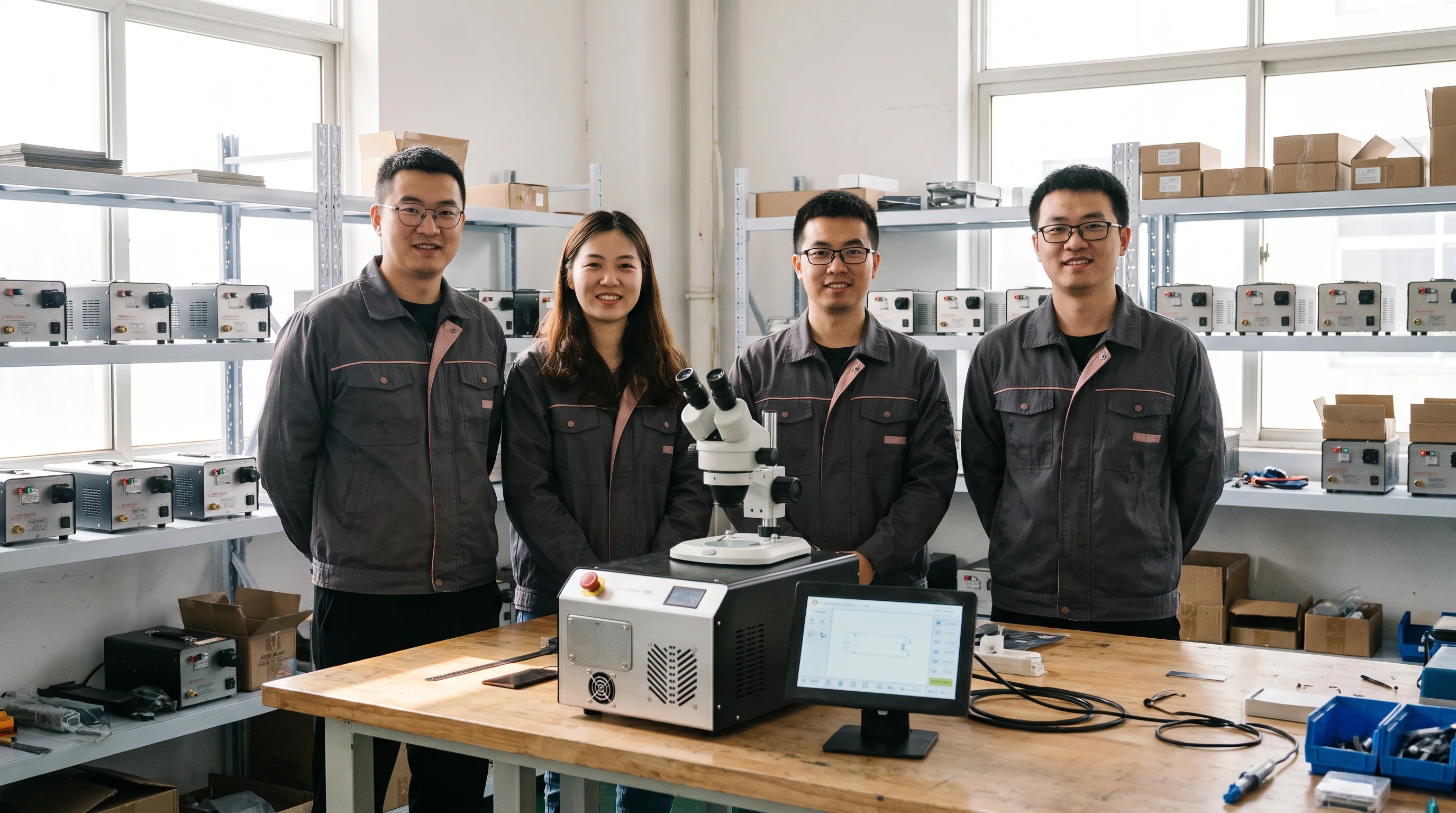
Made hereBought in
A trading company cannot draw this line. An assembler draws it around the cabinet.
Ask every supplier to draw the same line through their own machine, and compare where each puts it.
What the line separates
Two things in an M3 are ours from schematic to finished assembly, and they are the two parts a trading company cannot describe in any detail.
The unit that feeds the QCW source, with the Infineon power stage on it. Drawn here, which is why a fault in it is diagnosed at board level rather than by swapping a module.
The source that does the welding, built and coupled here. A jeweler meets the result as a spot that behaves the same way every time the foot switch goes down, on the two hundredth pulse as on the first.
Because the image is what the operator aims with.
Because the power stage is where the heat accumulates.
Because the protective lens has to survive the work.
Because switchgear with a name on it is not worth reinventing.
The specification sheet says the same thing this page does. Read the specification sheet
Reasons, not a parts list
Every part on this list is bought because buying it is the better engineering decision, and each argument is short enough to check.
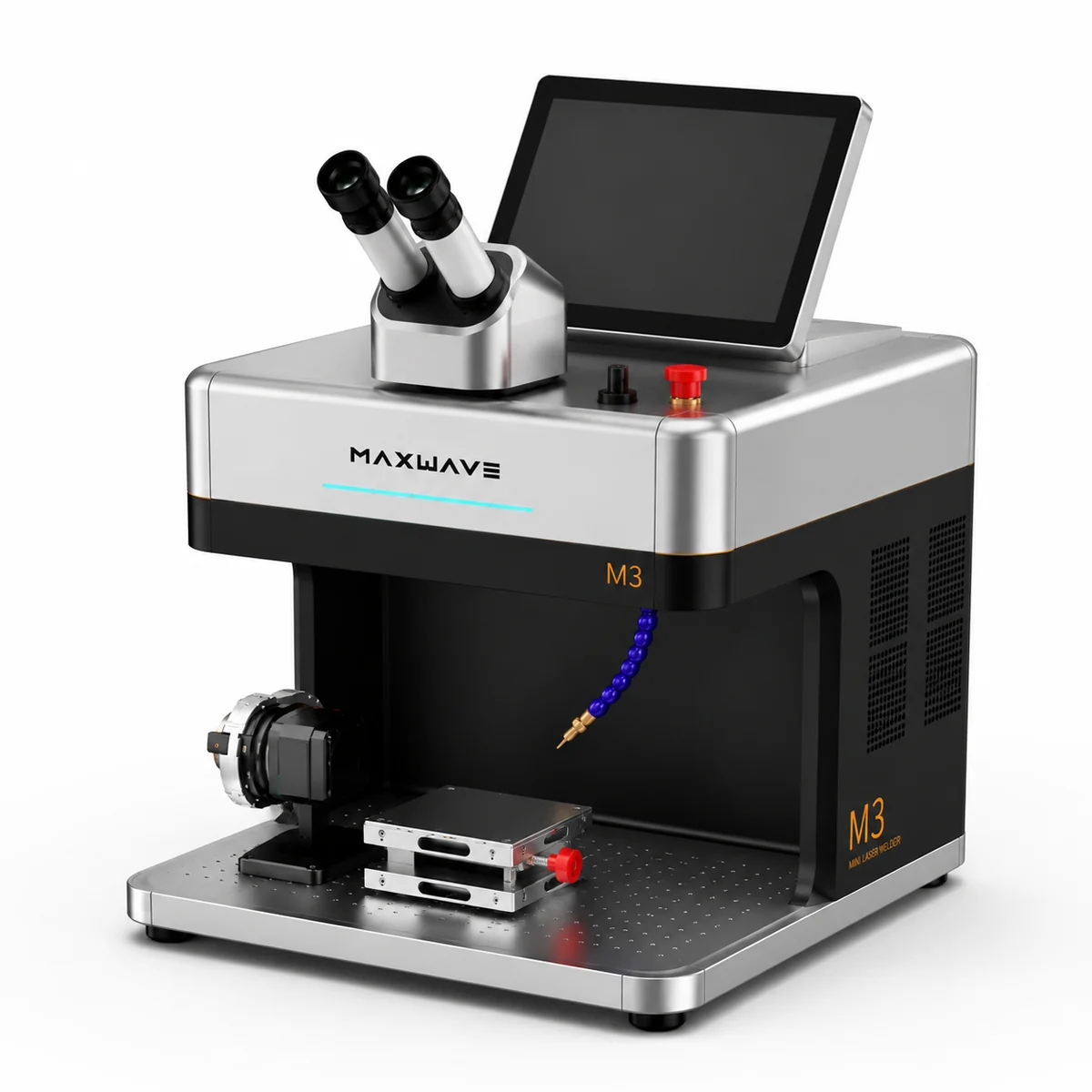
One question, three answers
Ask every supplier on your shortlist to draw the same line through their own machine. Where they put it tells you what they are.
Trading company
Everything falls on the bought side.
The line exists, but nothing sits on the left of it. Ask which parts were designed in the building you are writing to, and the answer is a supplier list.
Assembler
The box is theirs. The source is not.
Modules go in, a badge goes on. A fault inside a bought module is diagnosed by swapping it, which is why the machine has to travel.
This factory
Two parts made. Four parts named.
The power supply and the QCW source are ours. The rest is bought and said out loud, the only version of this answer you can check against a specification sheet.
The arithmetic behind it
Developing a laser power supply and a fiber source in house is expensive, and it only pays back if everything you sell uses them. A company with twelve models buys modules instead. That choice is arithmetic, and the buyer inherits the consequences.
If your source is a bought module, your parameter set is whatever the module exposes. If you built it, the pulse behaviour is something you can change.
A failure inside a bought module is diagnosed by swapping it, so a large assembly ships out. A failure inside a power stage we drew is diagnosed at board level, by people who have the drawing.
Both of them visible
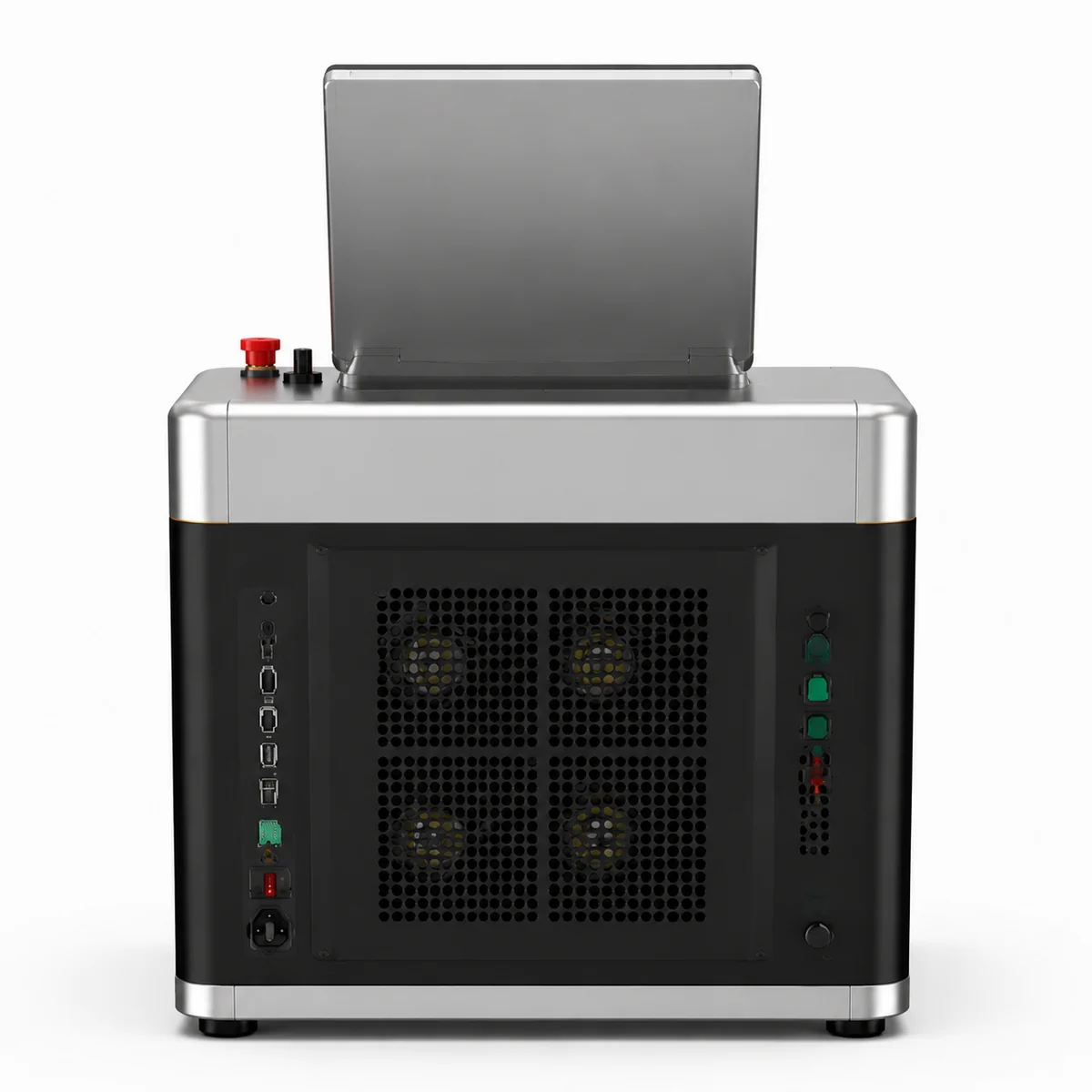
Where a machine can be stopped
An M3 passes four stations, and each one has a name because each one is a place where a machine can be stopped.
The station that exists because the power supply is ours: the unit that feeds the QCW source, with the Infineon power stage and the voltage regulation stage on it.
Stops a machine whenA regulation stage reads outside its window on the bench test, and no source is coupled to it until it does not.
Where the QCW fiber source is built and coupled. Coupling decides beam quality, and beam quality is what reaches the bench as a spot that repeats.
Stops a machine whenA coupled source will not hold its spot across a run, which is caught here rather than in your workshop.
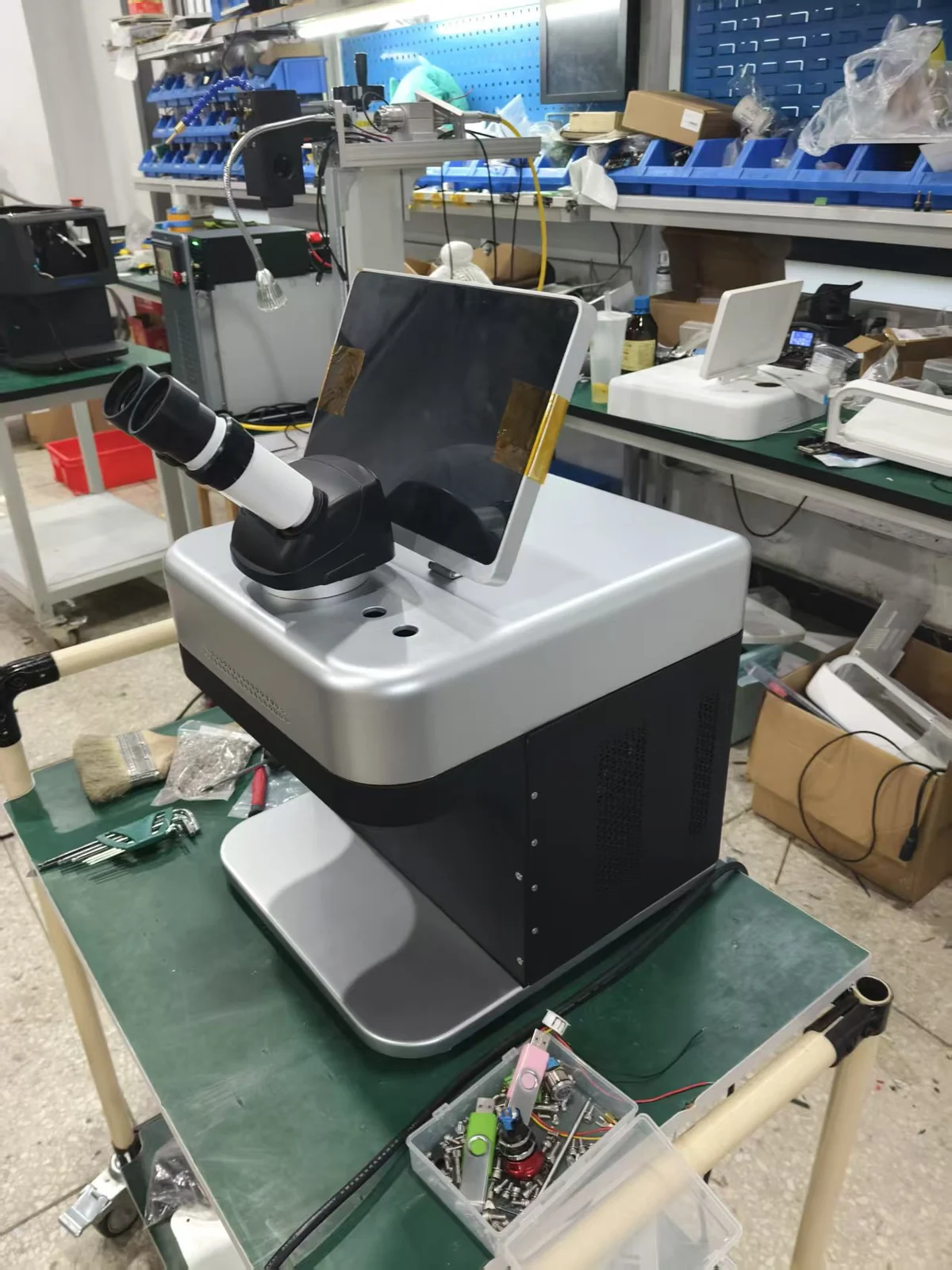
The cabinet, the 10 inch Android screen, the microscope and camera, the welding head and the galvo head, the air cooling and the wiring, built in the order you will meet them.
Stops a machine whenTwo heads, one cabinet and one screen do not come up together on first power.
The only station whose job is to reject the work of the other three. Who signs, and where rejected work goes back to, is the part that matters.
Stops a machine whenAny line on the checklist is unsigned. The crate does not close on a sheet with a gap in it.

The picture establishes the shell. The four station names establish what goes on inside it, and that is the part worth reading.
Inspection does not report to assembly. That is the only arrangement under which it can send work back.
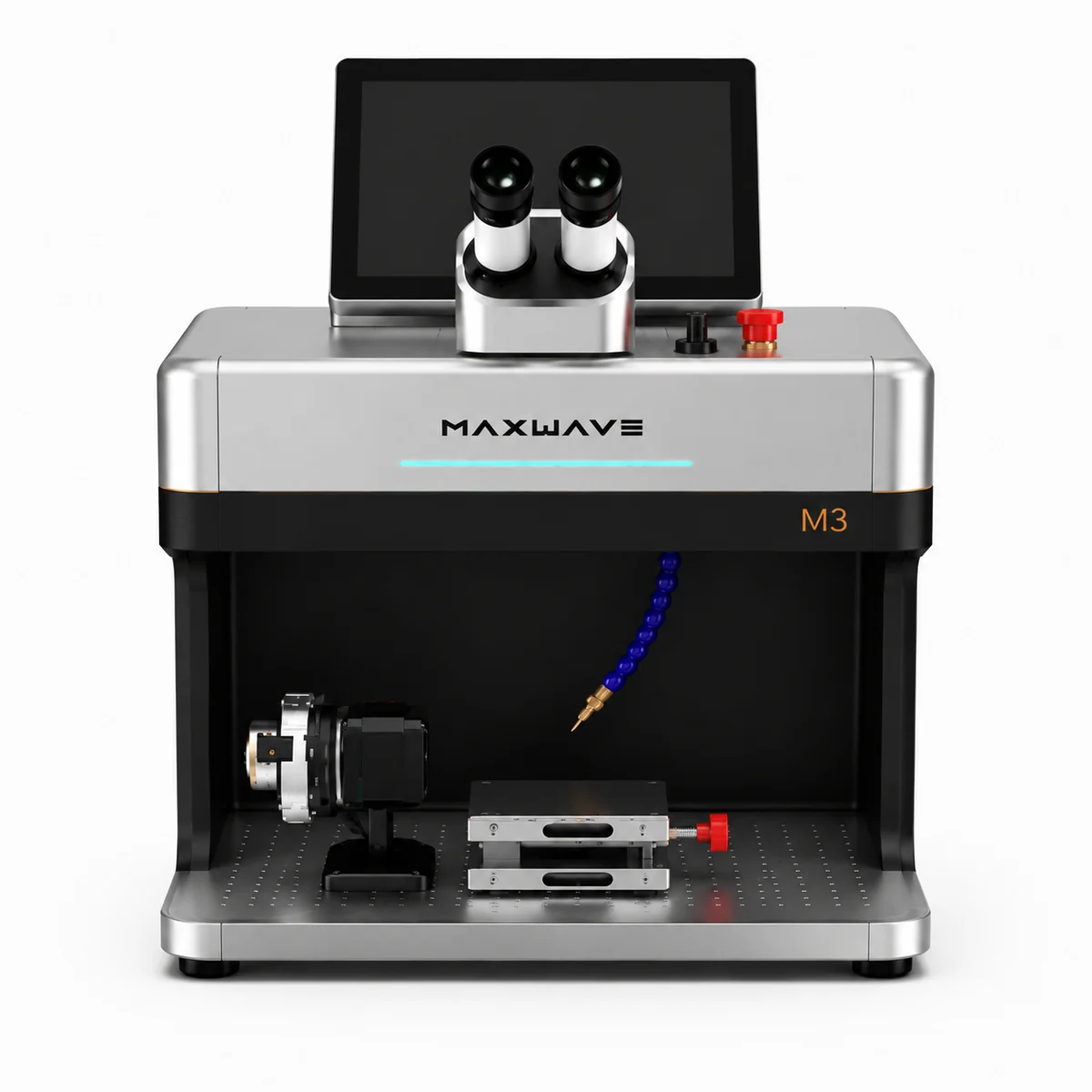
The fourth station
Not a sample from the batch, not the first one off the run. Each unit goes through one at a time against a Quality Inspection Checklist.
It returns to the station that owns the fault, the fault is fixed there, and the machine is inspected again from the top of the sheet rather than the line it failed on.
If a line on the sheet fails on unit after unit, it goes to the people who drew the thing rather than the people who assembled it.
Four kinds of work
The electronics and optics people who build the power stage and couple the source are the same people who answer when a support question turns out to be about either.
Power supply and source. Reachable through support rather than sealed off behind somebody else’s parts list.
Final assembly. The machine you will actually use is put together here, in the order you will meet it.
A separate role, for the reason above. Engineering sits across all four, because a drawing change has to be walked to the bench that builds it.
What a report is able to change
Every supplier collects fault reports. The difference is what a report is able to change. With one product line a fault cannot become a note against a future model, because there is no future model waiting to absorb it.
A description and a video, taken at a bench with the screen visible.
The same job, the same metal, the same settings, on a machine here.
Named to a stage or a part, not to a symptom that has to be escalated.
Either the design changes, or the inspection sheet changes.
Many faults are not a part that is wrong but a condition nobody was checking for. A new line on the sheet catches it on every unit from then on, which is why the inspection sheet grows rather than staying the document it was two years ago.
The next machine is built from the list the change went onto, and no fix is held back as a feature for a successor.
The other branch
Not reproducing usually means something at your bench is different from this one, and three things account for nearly all of it. Nothing changes in the build on a report we could not reproduce, because a change made on a guess is a change nobody can inspect for.
The machine you already own
A company that improves its only machine has to answer for the one somebody bought last year. Three cases, separated honestly.
What we do not do is discontinue your machine. There is one product line, so a part for a machine built earlier is a part for the machine we are building now.
No model number to look up
Most equipment support asks which model you have, then which firmware, then transfers you. None of that exists here.
There is one machine, and everybody who answers has worked on it. You describe what the machine did, and the answer is about your parameters, your metal and your piece. A question that turns out to be electrical or optical reaches the people who designed those.
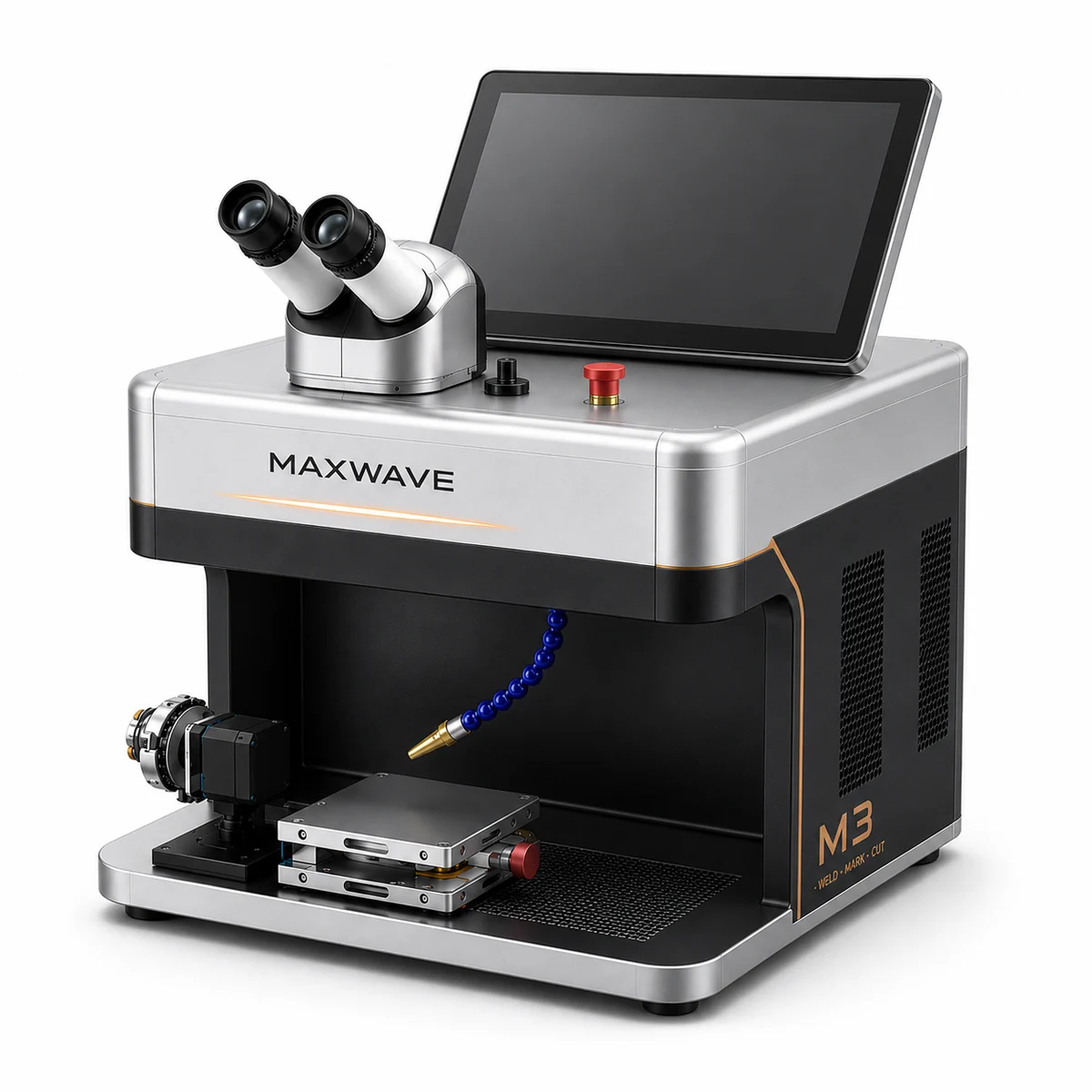
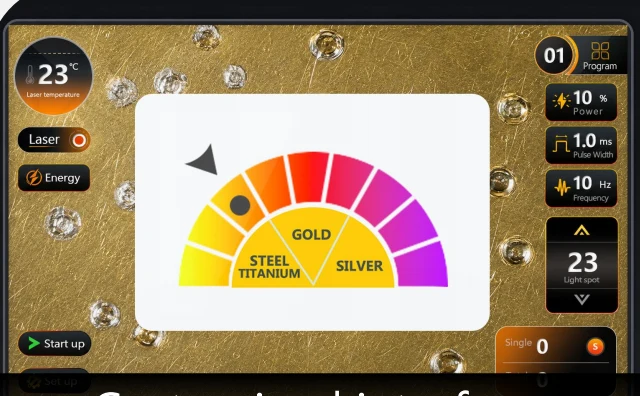
On the same 10 inch Android screen used to run it, in English and Chinese with other languages on request. A new operator learns from the machine in front of them.
The part replaced in normal running is the protective lens, and fitting one is bench work. Installation drawings and repair guidance are provided rather than withheld.
Before money changes hands
Everything on this page is checkable before you order, in the order the requests cost you least.
We provide both, and providing them before an order rather than after one is the test.
Energy that wanders during a long run of the same weld, or a spot not landing where the microscope says it should.
One repair, one blank, whatever you do most often. It comes back with the source, the spot, the pulse settings and the preset written down.
Selling direct, so no layer in between
There is no layer between you and the bench, so it is worth saying who handles what.
Their first job is not a quotation, it is working out what you make and repair, because the configuration follows from the work: the MOPA tier, the rotary device, the fixture and fume extraction, and your mains supply.
The parameter record that comes back is written by whoever ran it. Anything the sales engineer cannot answer goes to engineering rather than being guessed at.
They take over once a build is confirmed, and the stage ends at the inspection signature.
Pre-dispatch photographs and video, the forwarder, and one-to-one tracking on VIP orders.
Not a separate call centre, and the sales engineer you started with still knows what you make. That continuity is the argument for buying direct rather than through a reseller who forwards the question and waits.
Boundaries, plainly
A supplier who claims everything is a supplier you cannot plan around. Five things stay off the list.
One machine, improved on one bill of materials.
Send Us a PieceThe second bench
A replacement or a second bench should not be a new evaluation. With one product line it is not.
Same source, same power supply, same interface, so an operator trained on one is trained on both and the recipes your shop has built up stay worth something. With multi-model suppliers the second machine is a different machine.
It is the protective lens, a far shorter list than a lamp-pumped welder keeps over the same period. The fiber sources are rated above 100,000 hours, a rating on the source rather than a promise about the machine.
They are the only spares there are. Nothing is discontinued to make room for a new model, and interface changes are versions of the same interface.
Mostly people who will use it themselves
Mostly overseas, which is why support is built around a screen you can share over Wi-Fi and documentation you can read before you order.
We publish no customer names, counts or case studies. Nobody has agreed to have their shop used as our marketing, and an invented figure is worth less than the piece you can send us this week.
Two ways to start, both free
Ask for the installation drawings and repair guidance and read them. Or send one piece, tell us the job you do most often, and get it back welded with the settings written down.