Permanent Jewelry Equipment That Welds the Chain, Cuts the Charm, Marks the Name
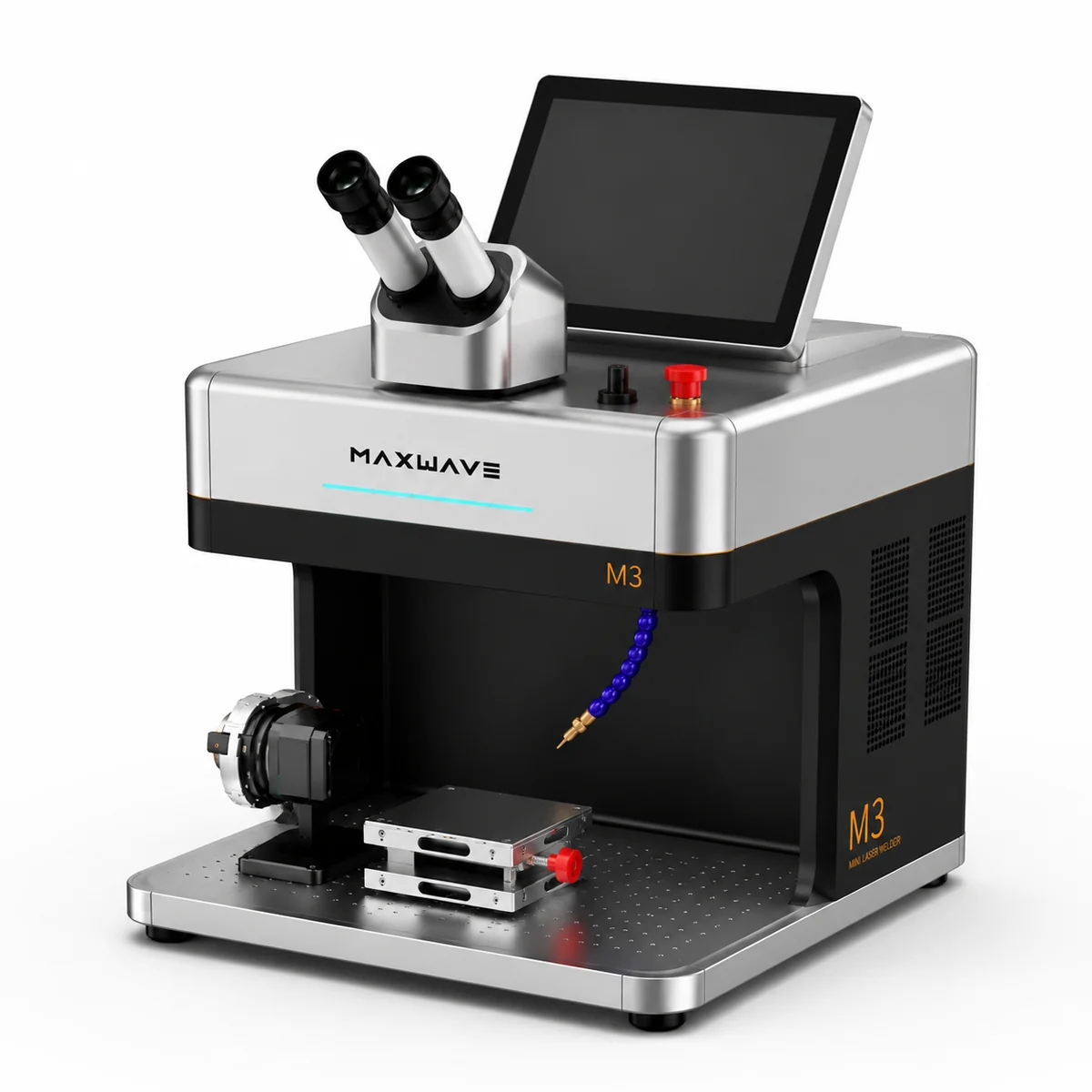
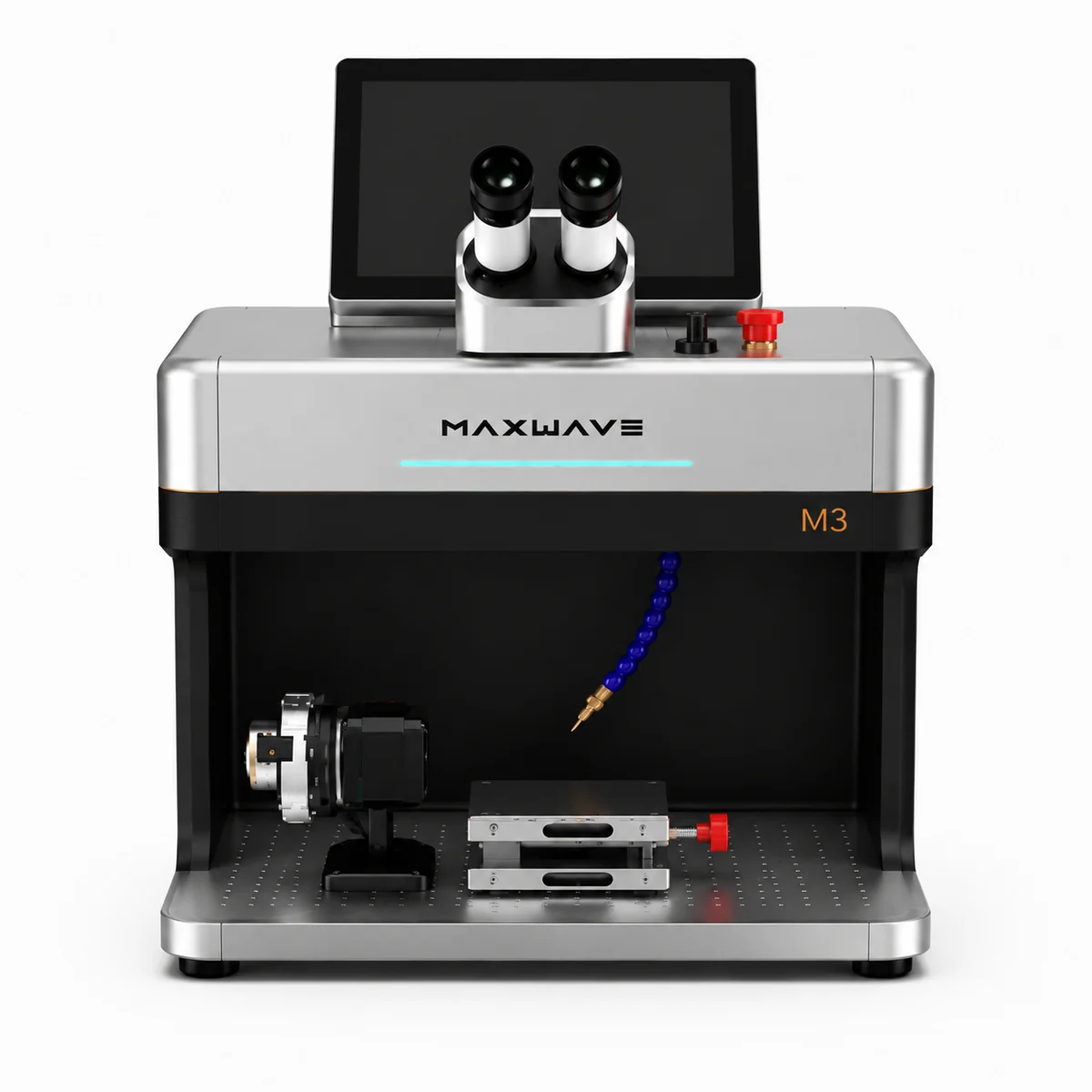
Permanent jewelry equipment for the whole of the business, not only the moment at the wrist. A QCW fiber source closes the chain under a 10X binocular microscope while the customer watches on a 10-inch screen. A second source in the same cabinet cuts and marks the charms, tags and initials nobody else at the event is selling. Built for market and pop-up traders, bridal and event work, and stores adding a permanent jewelry counter.
Strip a permanent jewelry business back and three things bring in money. Each one is a different machine operation, and on most benches each one sits on a different bill.
QCW welding source
Pending photo · the closed link
Close the chain
A wrist, an ankle or a neck, fitted in front of the person wearing it, with no clasp on the finished piece. A welding operation, and the reason the customer sat down.
The one the customer books
MOPA source · cutting
Pending photo · charms cut from sheet
Cut the charm
Initials, tags, birth-flower discs, small graphics: the pieces that turn one chain sale into a chain and three charms. Cut from sheet, or bought from the supplier every other stall uses.
The basket
MOPA source · marking
Pending photo · name and date on a disc
Mark the name
The name, the date, the coordinates or the tiny message, put on before the piece goes on. A marking operation, and the step that turns a stock charm into a one-off.
The commission
Most benches · three bills
A welding tool
A wholesale charm account
A marking machine, or a subcontractor with a turnaround
On an M3 · one cabinet
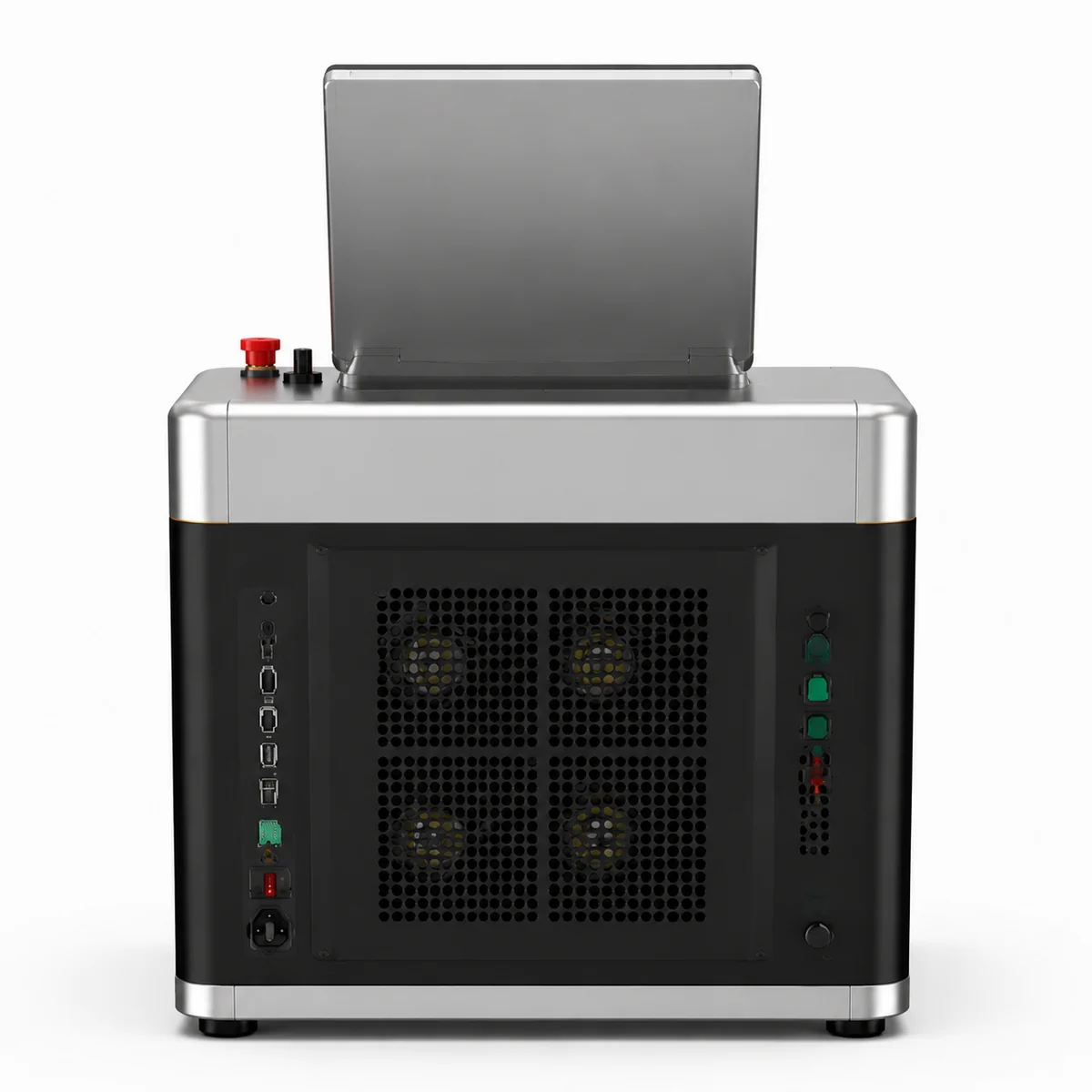
One 30 kg box, two laser sources inside
One screen
One power lead
Which job earns most depends on where you trade. A market stall leans on the chain. A counter with regulars leans on the charms they come back for.
This business runs in two places, and the machine has to survive both: a table it reaches by car, and a counter it never leaves.
Market · bridal event · shop-in-shop
Arrives in a car, leaves in one
A cabinet one person plans around300 × 340 × 320 mm and 30 kg. Packed for the road it is 500 × 520 × 540 mm and 45 kg, in the packing it shipped in.
No chiller, no water, no hoseAir cooled through the rear vent panel. Nothing to plumb, nothing to run across a public floor, nothing to drain at the end of the day.
No separate computerThe interface is the 10-inch 1280P capacitive touch screen in the lid, running Android.
One single-phase leadSet up between arriving and opening: table, machine, lead, pedal.
300 × 340 × 320 mm
The same machine on both tables.
Existing store · permanent counter
A fixture the customer looks at
At the end of the benchWhere the customer side of the counter meets the working side. They sit on one side of it, you work on the other.
Screen turned toward themThe lid screen faces the person having the chain fitted while you work down the eyepieces.
A moulded shell with a lit stripOn a counter the equipment is part of what the customer is looking at. This reads as an instrument, not as plant.
The logo panel can be yoursYour name on the machine your customers photograph.
Pending photo · pop-up tablePending photo · store counter
Supply
AC 220 V · 50 Hz · 2 A
Total rating
2 kW, single phase
Temperature
0–40 °C
Humidity
up to 80 %
That operating window is the envelope a marquee in August or an unheated hall in February has to sit inside.
No darkened corner, no industrial plant. A moulded cabinet with a lit strip and a screen, on a table at normal counter height. At that height the screen is also visible to whoever is next in line: the fitting in progress advertises the next one, which is why pop-up traders turn the lid toward the aisle.
The part the business is built on
The Customer’s View of the Weld
Nobody pays for a welded joint. They pay for watching it happen.
The same view, at the same time
You place the pulse down the eyepieces at the magnification the work needs. The screen carries the identical view in full colour, fed by the camera, so what you do and what they see are the same event.
The link that hung loose a moment ago is continuous, on a screen the size of a tablet, at a magnification no one gets with their own eyes. They did not take your word for it. They watched.
The conversation afterwards
A customer who watched the joint form does not ask whether it will hold in the shower. They have seen what it is. They ask what else you make, which is the question worth having, and the charm tray is already on the table.
Every question after that is a selling question: a second chain, an anklet to match, initials for the children, a date on a tag. The screen did the reassuring, so the talk goes straight to the tray.
A second person learns standing beside you
Parameters, the preset in use and the live camera view share that screen. A new team member trains at your shoulder instead of waiting for a turn at the eyepieces. On a busy event day that is how the queue keeps moving.
The screen also settles doubts before they start. A customer who saw the joint form on their own wrist, and filmed it, carries their own proof of what was done.
Set from the screen, not by turning a barrel until it feels right. The twelfth customer of the day gets the spot the first one got, because the number lives on the screen and not in your fingers.
0.2–15 ms · 1–20 Hz
Pulse width and frequency
The difference between one placed pulse and a short train of them. Chain work is almost always single pulses, with a look between each one.
Both hands on the piece
Released by foot pedal
A wrist is alive. It moves, breathes, shifts when someone laughs. Both hands hold the chain ends in register the entire time, and only your foot fires the laser. Nothing in your hands is squeezed, triggered or set down.
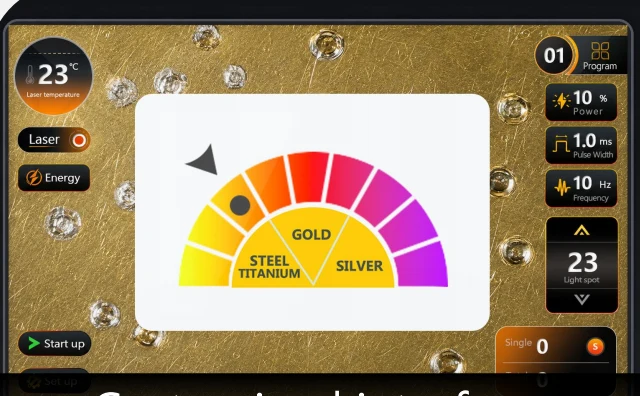
GOLD · STEEL · TITANIUM · SILVER
The material dial
Materials are chosen by preset, not built from scratch. For the chain stock most permanent jewelry businesses buy, the dial position is the job.
The dial as it appears on the machine.
Gold
Silver
Platinum
Titanium
Copper
Aluminium
Steel
The weldable list runs wider than the dial. For a metal with no position of its own, start from the nearest position and correct on the first pulse with the microscope in front of you. No invented recipe.
The method any laser bench uses, and it takes less effort than fitting the chain.
Nobody’s first pulse of the day should land on a customer.
An offcut from the same spool
Same alloy, same gauge as the chain about to be fitted. A different spool is a different test.
One pulse under the microscope
Placed at the settings you intend to use on the customer, on scrap, where a wrong guess costs nothing.
Read three things
Did the pulse land where the spot said it would. What it did to the surface around it. Whether the two ends drew together. Adjust, place another.
Write it next to the spool
Settings confirmed for that spool go beside the spool reference, not into memory across a weekend. Then the wrist.
Pending photo · trial pulses on an offcutPending photo · settings card on the spool
The next time that stock comes out of the drawer, the trial pulse is a confirmation, not a search. It stays one, because the spot is an electrically set number and the preset is a dial position.
Restock in a different alloy or gauge and it is a new spool with its own trial pulse. That discipline is why a bench working this way can fit an unfamiliar chain in the afternoon without it being a gamble.
Pending photo · a charm tray cut and marked in-house
The cutting side
Your Own Charms, Tags and Initials
The charm tray is where a permanent jewelry business either has its own product or sells the same catalogue as the stall two rows over. The MOPA source in the same cabinet changes that. Businesses come for the welding and stay for this.
70 × 70 mm cutting field · red light walks the outline on the sheet before anything fires
The proven list is the tray
Proven on this source: thin sheet cut to an outline. Name pieces in script, tags and pendant blanks, letter pieces, small metal graphics.
Read that against a charm tray: initials in several sizes, a dated tag, a heart, a star, a pet silhouette, a club emblem a customer brought in as a file, a bar in a length no supplier stocks.
Fixture and extraction are standard kit
For cutting they belong with the job, not on an options list. The cutting fixture holds the sheet flat, because a fine stroke lifts as the outline breaks through, and a lifted stroke is a scrapped blank.
Fume extraction runs while you cut, because a day of cutting metal over an open bench has no place in a room where customers are also served.
A bridal party of six
Six chains, plus a tray of charms no one else at that venue can sell. That is the gap between a chain sale and a basket.
A customer choosing between four initials chooses from your range. A regular comes back for the next piece in the set.
Artwork arrives as a file
Red light walks the outline
Cut flat on the fixture
Marked inside the same field
On the tray
Pending photo · outline on the sheetPending photo · a bridal set of six
Artwork emailed on Tuesday is on the tray on Saturday, cut from your own sheet, with no subcontractor’s turnaround between the order and the event.
Marking is the same source as cutting and the same 70 × 70 mm field. A piece that has just been cut is marked without leaving the bench.
0.01 mm · 7000 mm/s
A name that reads as a name
Marking accuracy and galvo speed together decide whether small text on a small disc reads as lettering or as a scratch. Depth is a choice: a surface anneal or an engraved groove from the same MOPA source.
Colour on two metals
Know which ones
Stainless steel and brass take colour. Anodized aluminium marks black. Precious metals mark without colour, which is the right answer for the chain and charm stock this business mostly sells.
USB · Bluetooth · Wi-Fi
The files customers send
Artwork moves to the screen on the machine in the format it arrived in. No conversion step on a laptop you did not bring.
Accepted formats
PLT
DXF
DST
AI
BMP
JPG
PNG
TIF
CAD
CDR
DWG
and more
Depth, anneal against groove, and colour are covered in full on the marking page.
Inside-band work on a ring needs the rotary device to turn the curve under the beam. For that job it is the standard kit, not an accessory.
Pending photo · marked discsPending photo · colour on brass and steel
The customer already cuts this business into two halves. The machine follows the same cut.
The evening before · MOPA side
Pending photo · the evening batch
Batch work that wants a batch
Cut the weekend’s blanks
Mark the named orders
Cut the tags
Clear the waste
Check the edges
Load the tray
The quiet weekday on a counter and the morning of set-up are the same half.
Customer in front of you · welding only
Pending photo · a fitting at the stall
One head, start to finish
Chain out
Measured
Ends together
Pulse
On the wrist
Paid
Nothing is cut and nothing is marked while somebody waits. The head never changes during a fitting.
Finish the MOPA work before the doors open and take finished stock to the event. The changeover lands between two halves of the day, never inside a customer’s fitting.
Two heads, one cabinet, one screen. The heads do not share a datum: a piece moved from one to the other is held again, and the MOPA red light walks the outline on the actual piece to find it.
A page like this usually carries a set of numbers. These are left out on purpose. Here is exactly which ones, and what replaces them.
Chain gauge range
Not published
Maximum or minimum section
Not published
Settings table by chain type
Not published
Working distance to skin, on-body accessories, a procedure for welding against a person
Open with engineering
The specification sheet holds no such limits
Generating them for a page is off the table. An invented number gets quoted back by a buyer standing at a market stall with a customer’s wrist in their hands: the worst possible place for a number nobody measured.
On-body work is a safety question
It belongs to the factory and to the rules where you trade, not to marketing copy. The question is open with engineering. The answer appears here as a specification when it comes from the factory. The working method today: a first pulse on an offcut under the microscope, then the wrist.
Pending photo · sample and settings cardPending photo · the joint, photographed
Send the chain you buy. It is welded on an M3, photographed, and returned with the four settings written beside it: the answer for your stock, on a piece you can pull apart on your own bench. The offer stands whether or not you order a machine.
Scope, not performance
A Welding Tool and a Wider Bench
Most people reading this have a hand-held pulse arc welding pen open in another tab. That tool’s performance is not characterised here, because nobody on this side has measured it. What can be stated exactly is scope: how many of the three jobs sit on your own table.
The job
A dedicated welding tool
The M3
Close the chain
The chain closes. This is the job the tool exists for.
The chain closes under a 10X microscope, on a screen the customer watches.
Fill the charm tray
Charms come from a wholesaler, and sit on somebody else’s tray at the same event.
Cut from your own sheet inside a 70 × 70 mm field. Your range, your artwork.
Put the name on
Names go out to a marking service, with a turnaround attached.
Marked at the bench that cut the piece, at 0.01 mm accuracy.
Upkeep over the years
Set by that tool’s maker. Ask them.
The routine consumable is the protective lens. No chiller, no water loop, no lamp.
Pending photo · the same tray twicePending photo · a tray that is only yours
Not a better pulse. A wider bench. The welding source gets the customer to sit down. The cutting and marking source decides what they leave holding. Same table, same power lead, same screen.
Post a length of the chain you buy, in the gauge and alloy you stock, and say what you sell with it. It is welded on an M3, photographed, and sent back with the settings written down.
Chain alloy and gauge
What you sell with it
Stall, counter, or both
Mains at your events
The offer stands whether or not you order a machine.