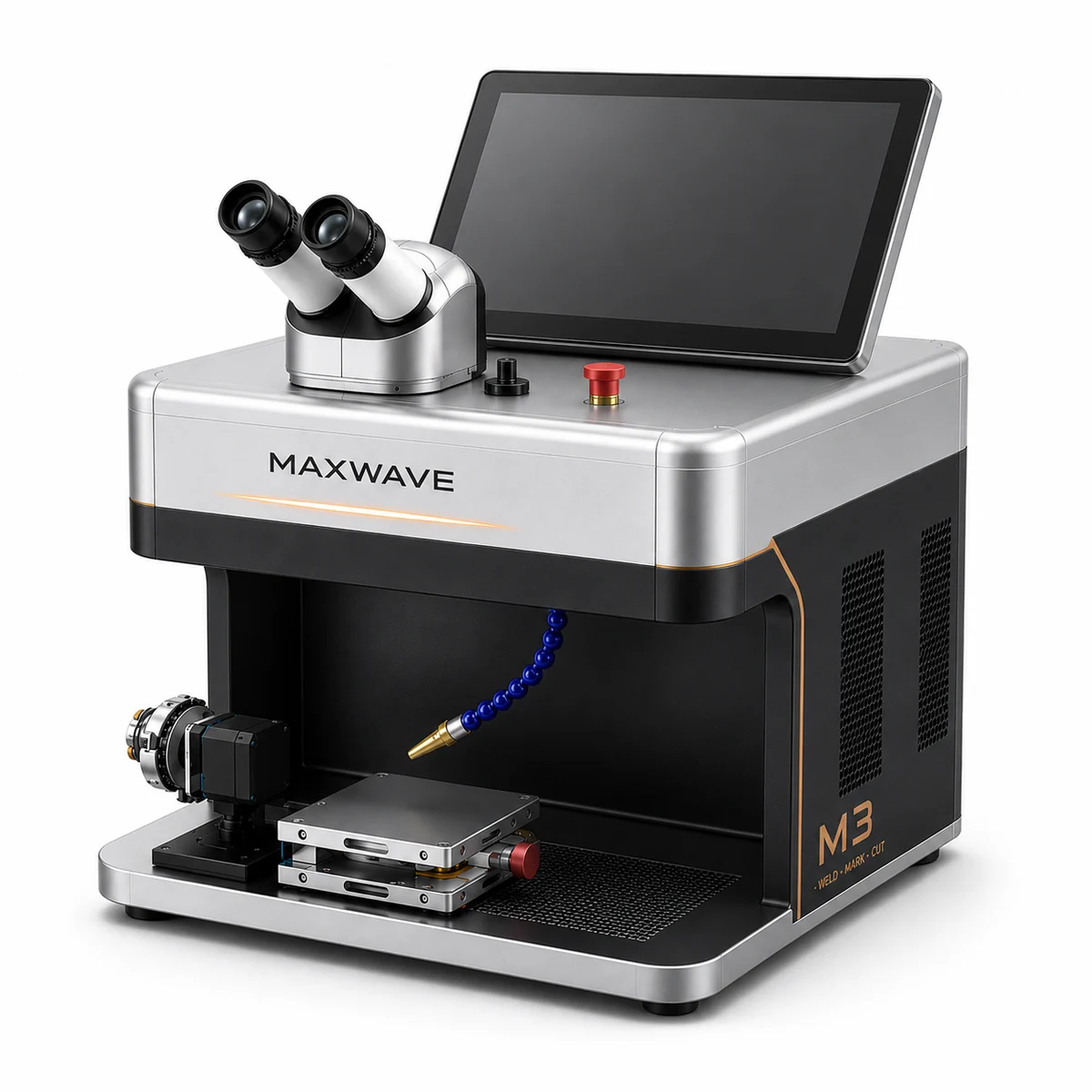
M3 · Full data sheet

Jewelry Laser Welder Specifications, Source by Source

Two 1064 nm fiber sources sit in one cabinet: a QCW source for welding, a MOPA source for marking, engraving and cutting. Every figure below is grouped by the source it belongs to, because a welding number and a marking number on this machine are not comparable to each other.

FRONT ELEVATION 10" ANDROID SIDE ELEVATION VENT WALL TOP VIEW SCREEN EDGE 1064 nm · TWO SOURCES QCW — WELD MOPA — MARK / ENGRAVE / CUT AIR COOLED · NO CHILLER 30 kg · 2 kW SINGLE PHASE RATED SOURCE LIFE >100,000 h 300 mm 340 mm 320 mm
Dimensions · weight300 × 340 × 320 mm
30 kg
Mains supplyAC 220 V / 50 Hz / 2 A
2 kW total
CoolingAir cooled
no external chiller
Rated source lifeAbove 100,000 h
wall-plug above 30%
WarrantySource 2 years
machine 1 year

Whole machine

Machine data

Complete Jewelry Laser Welder Specifications

Sixteen rows of jewelry laser welder specifications describing the machine as a whole, independent of which source is firing. Weight, mains supply, the ambient range the machine is rated for and what the warranty leaves out are all on the page, not in the paperwork under the lid.

M3 machine specifications
ItemSpecification
FunctionsMachineWelding, marking and engraving, cutting
Laser architectureMachine1064 nm dual fiber sources: QCW for welding, MOPA for marking, engraving and cutting
DimensionsMachine300 × 340 × 320 mm
WeightMachine30 kg
Packed size and weightMachine500 × 520 × 540 mm, 45 kg
CoolingMachineAir cooled, no external chiller
Power supplyMachineAC 220 V / 50 Hz / 2 A, 2 kW total
Operating environmentMachine0 to 40 °C, humidity 80 percent or below
Rated source lifeQCWMOPAAbove 100,000 hours
Wall-plug efficiencyQCWMOPAAbove 30 percent
ControlMachine10 inch 1280P capacitive touchscreen, Android
ObservationQCW10X binocular microscope, 20X lens, Sony 8 megapixel full colour HD camera
ConnectivityMachineBluetooth, Wi-Fi, USB
Interface languagesMachineChinese and English, other languages on request
WarrantyMachineLaser source 2 years, machine 1 year, lenses and consumable parts not covered
IncludedMachineMini ultrasonic jewelry cleaner

45 kg packed against 30 kg on the bench

Two numbers, two questions. 45 kg in a 500 × 520 × 540 mm case decides how the machine reaches you and who carries it through the door. 30 kg is what stands on the counter afterwards, and whether a bench can take it without being rebuilt.

Source life sits apart from the warranty line

Above 100,000 hours rates the fiber source and nothing else. It is on its own row for that reason, two rows from the cover: two years on the source, one year on the machine, lenses and consumable parts excluded.

One row is not a performance figure

A mini ultrasonic jewelry cleaner is listed because it ships in the case, not because it describes the machine. Every other row above it does.

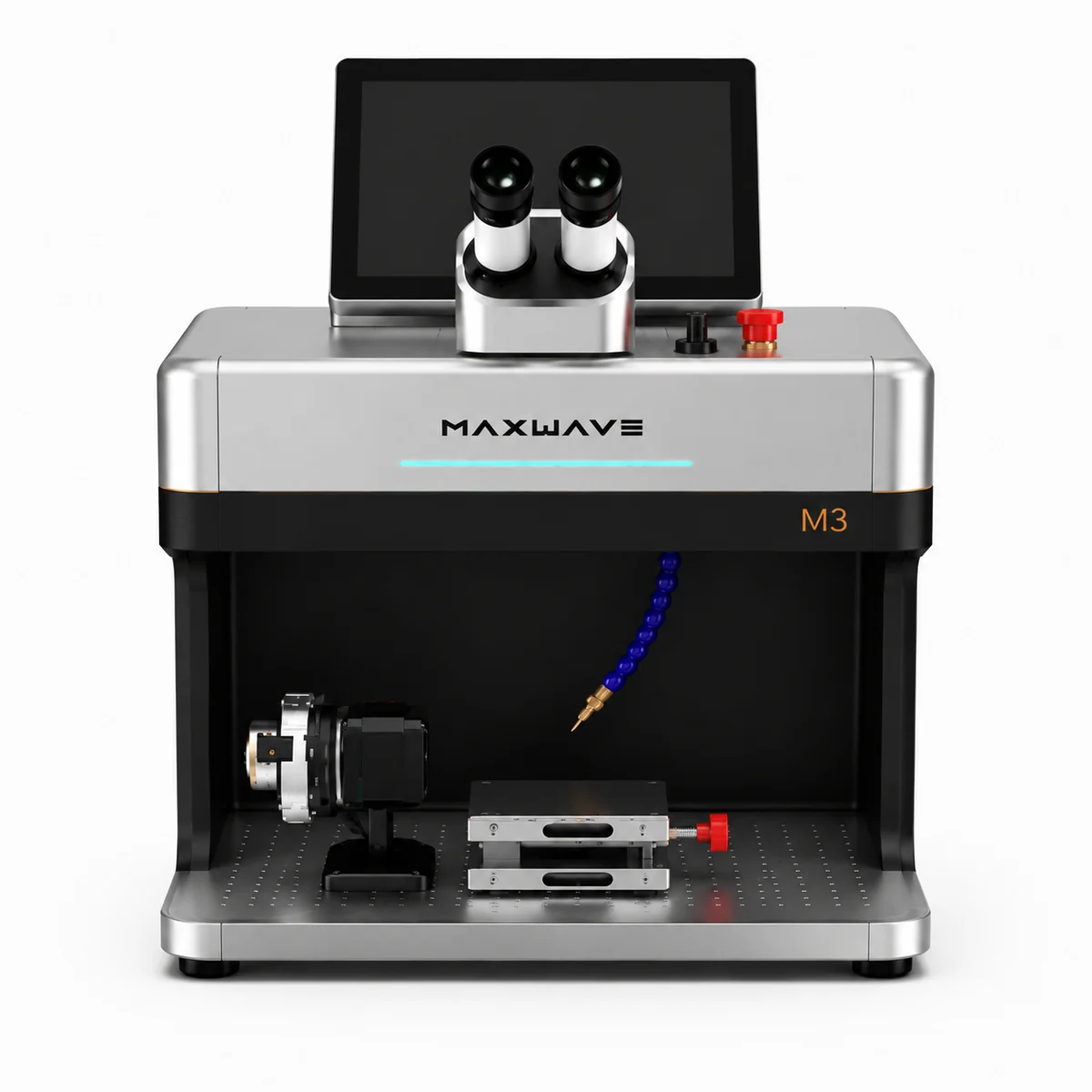
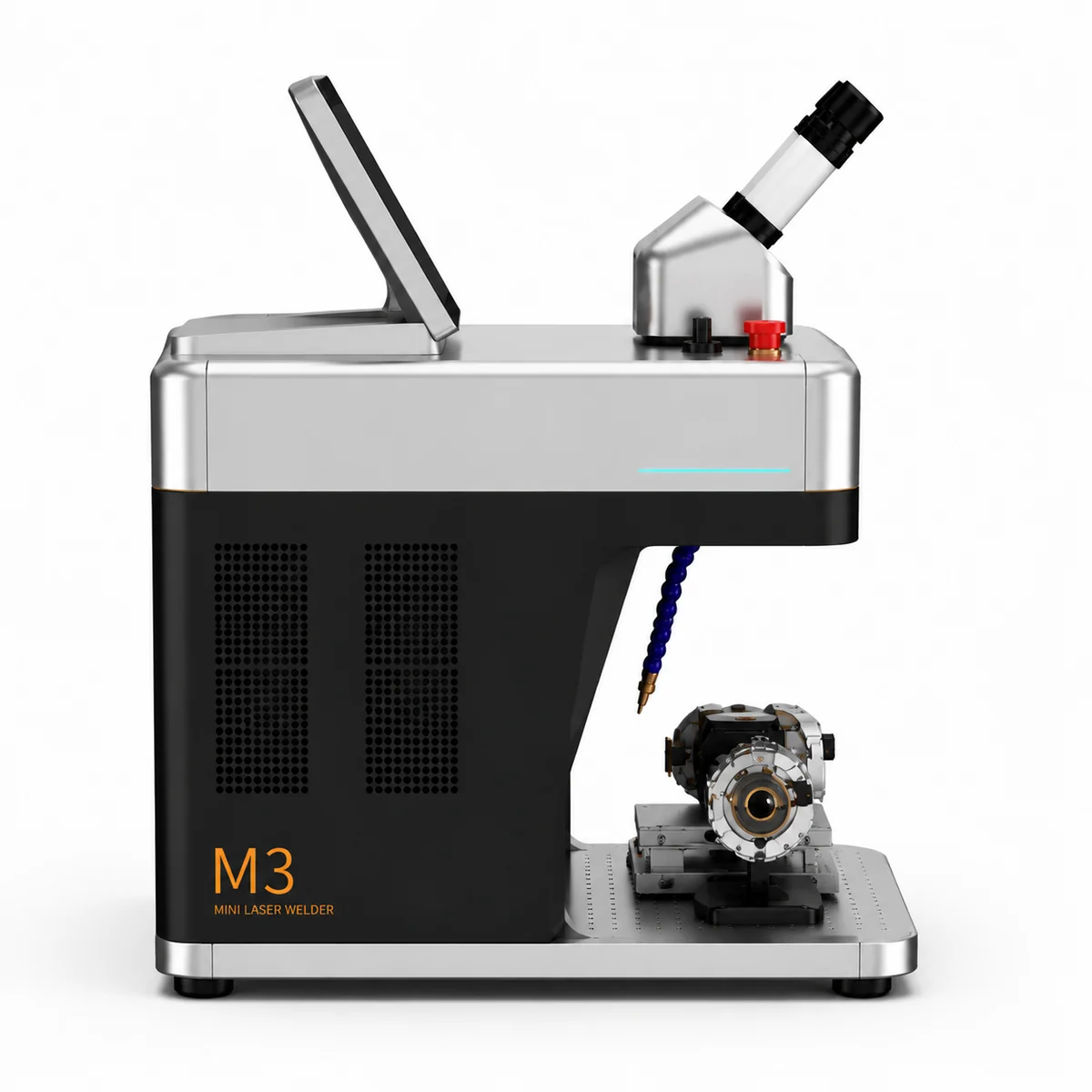
The M3 seen from the front, the machine these jewelry laser welder specifications describe row by row
One cabinet. Every row in the table above belongs to this.
500 mm45 kg Pending · packed case AC 220 V / 50 Hz / 2 A Pending · rating plate

QCWMOPA

Architecture

Two Sources, Two Heads, One Cabinet

A QCW source welds. A MOPA source marks, engraves and cuts. Two sources, two heads, two software interfaces, one cabinet, one screen.

That is not redundancy. The two jobs sit in different physical regimes, and neither source can be asked to cover the other by changing a setting.

Shared

The cabinet. The single-phase supply. The air cooling. The 10 inch Android screen. The power stage, with its German Infineon IGBT and its voltage regulation stage. And the one routine consumable, the protective lens.

Not shared

The head. The interface. The working position. That is why the tables below are split by source rather than merged into one column.

QCW

Single shots, placed by eye

Jewelry welding is a sequence of discrete melt points placed by hand under the microscope, each a millisecond-scale pulse fired from a pedal at one to twenty shots per second.

  • Pulse 0.2–15 ms
  • 1–20 Hz
  • Foot pedal
  • Spot 0.1–2.0 mm
ONE SHOT, PLACED BY EYE Pending · one shot
MOPA

A path, traced from a file

Marking and cutting are a galvo sweeping a beam across a field at 7000 mm/s at 20 to 80 kHz. One source places single shots where the operator is looking; the other traces a path far faster than a hand can move.

  • 20–80 kHz
  • 7000 mm/s
  • 70 × 70 mm field
  • Driven from a file
FILLED AREA · 7000 mm/s Pending · galvo sweep

No single-source machine has to explain this part, and it is the part a comparison sheet gets wrong most often.

ONE SCREEN Pending · two interfaces, one screen

QCW

Power figures

Peak Pulse Power Against Mains Draw

PEAK 120–1200 W AVERAGE = PEAK × DUTY 0.2–15 ms 1–20 Hz TIME
QCWPeak pulse power
120–1200 WThe power inside a single pulse while it is firing. Not a continuous output, and not a mains draw.
MachineMains draw
2 kWOn a single AC 220 V / 50 Hz / 2 A supply, both sources included.

Two figures, two different measurements

The QCW source is specified at 120 W to 1200 W, the machine at 2 kW total. Those two figures look contradictory on a spreadsheet, and they are the first thing an engineer challenges.

They are not contradictory because they measure different things. A QCW source fires for 0.2 to 15 ms at a time, at 1 to 20 Hz.

Average power is what the wall sees

Multiply the longest pulse by the highest frequency and the source is emitting for under a third of each second at the limit of both settings. Prong and finding work runs short pulses at low frequency, a small fraction of that again.

Average power on a pulsed source is peak power multiplied by that duty. Add the MOPA source at 10 W, 20 W or 60 W, the screen, the camera and the control electronics, and the machine still sits inside 2 kW.

The consequence is on your side of the wall: no three-phase supply to install, no dedicated circuit, and no electrician standing between delivery and the first weld.
QCW

Welding side

Welding Specifications, QCW Source

QCW welding source
ItemSpecification
SourceQCWQCW fiber, 120 W to 1200 W peak pulse power
Spot sizeQCW0.1 to 2.0 mm, motorized adjustment
Pulse widthQCW0.2 to 15 ms
FrequencyQCW1 to 20 Hz
Beam qualityQCWBPP 1 to 2 mm·mrad
TriggerQCWFoot pedal
Parameter handlingQCWOne-touch material presets
MaterialsQCWGold, silver, platinum, titanium, copper, aluminium, steel
0.1 mm Pending · spot closed 2.0 mm Pending · spot opened

Motorized spot0.1 to 2.0 mm

The range matters because the same machine closes onto a prong tip and opens out for a finishing pass across a shank seam. The motor matters more: a motor returns to a setting, while a manually adjusted spot is re-found by feel every time. Over twenty identical chain repairs that is one job repeated, not twenty separate judgments.

Beam qualityBPP 1 to 2 mm·mrad

BPP describes how tightly the beam can be focused and how steeply it falls off at the edge of the spot. On fine work that is what decides whether energy lands on the joint or spreads into the metal beside it.

TRIGGER Pending · foot pedal
Materials GoldSilverPlatinumTitaniumCopperAluminiumSteel

These rows say what each figure constrains, not how to set the four of them for a given joint.

QCW

Not on this sheet

Jewelry Laser Welder Specifications We Do Not Publish

Three rows, deliberately empty

  • Maximum weldable section, by alloy
  • Minimum workable piece size
  • Maximum sheet thickness

No value, no range, no approximation standing in for one.

SOLID SECTION Pending · solid shank

Why they are empty

We have no values we would stand behind across the alloy range, and a table we could not defend on your bench is worth less to you than this paragraph. Welding limits are not one number in any case: the same silver section behaves one way as a solid shank, another as a hollow wall, and differently again beside a stone that has been heat treated.

HOLLOW WALL Pending · hollow wall

What we do instead

We answer it on your actual piece. Send the work, or a sample in the alloy and the section you deal with, and we run it on an M3 and send it back with the parameters used. That is an answer about your metal and your geometry rather than a row in a table.

How a sample is run and returned

MOPA

Marking side

Marking and Cutting Specifications, MOPA Source

MOPA marking, engraving and cutting source
ItemSpecification
SourceMOPAMOPA fiber, 10 W / 20 W / 60 W configurations
Beam qualityMOPA1.5
Repetition rateMOPA20 to 80 kHz
Marking accuracyMOPA0.01 mm
Galvo speedMOPA7000 mm/s
Engraving fieldMOPA70 × 70 mm
PositioningMOPARed light
File formatsMOPAPLT, DXF, DST, AI, BMP, JPG, JPEG, GIF, TGA, PNG, TIF, CAD, CDR, DWG and others
Colour rangeMOPAStainless steel and brass take colour, anodized aluminium marks black
Verified cut piecesMOPAName necklaces, tags, letter pieces, small metal graphics, sheet outlines
0.01 mm is marking accuracy
line widthstroke depth

It states how precisely the beam is placed inside the field. Stroke width comes from the beam and the parameters; depth is a parameter choice rather than a fixed property. A machine quoting 0.01 mm accuracy is not thereby claiming a 0.01 mm line.

The rotary device on the side of the machine, the accessory behind the inside-band rows of the MOPA source
Rotary device: a band turned under the beam.

M squared against BPP

Beam quality on this side is stated as M² 1.5, the metric used for a scanning beam, against BPP on the welding side. They are two different measures of two different beams inside the same cabinet. Lining them up in adjacent cells and calling one better is the most common misreading of this sheet.

STEELBRASSANODIZED Pending · colour range

Rate and speed describe throughput

20 to 80 kHz is how often the source fires and 7000 mm/s is how fast the beam crosses the work. Between them they set how long a filled area takes and how much heat builds under it. That is throughput, not quality.

70 mm Pending · tag in field

MOPAQCW

Where the datum is

Field, Welding Position and Red Light

MOPA — SCANNED FIELD ORIGIN 0,0 70 × 70 mm QCW — MICROSCOPE FOCUS NO COORDINATE RE-FIXTURED
  • MOPAOne origin, one working height, everything inside 70 × 70 mm
  • QCWThe microscope focus, no coordinate at all

The field belongs to the MOPA source

Everything that source does happens inside 70 × 70 mm, referenced to the same origin at the same working height. A piece cut in that field is already in position to be marked in it.

The welding position has no field

There is no scanned area on the welding side at all. The operator focuses through the 10X binocular microscope, holds the piece in both hands and fires from the pedal at whatever point the eyepiece is on. The datum is that focus, not a coordinate.

Red light replaces the shared datum

When a job crosses between the two sources the piece is re-fixtured. No coordinate system carries across from the welding position into the marking field, and we do not claim one.

TRACED ONTHE PIECE Pending · red light AFTER WELDINGSET AGAIN Pending · set again

Before the MOPA source fires it traces the artwork onto the actual piece, at the size and in the position it will be marked, so the operator sees where a serial number lands against the edge of a tag while moving it is still possible. On work just welded, and so no longer quite the shape the file assumed, that is the more reliable datum of the two.

Machine

Control and observation

Two Interfaces, One Screen

The 10 inch Android panel that carries both source interfaces described in these jewelry laser welder specifications
10 inch 1280P Android panel.
Pending · apprentice on screen
1080P / 1440P480P M3 observation systemcommon in this class
  • No host computer, so no computer specification on this sheet.
  • Files arrive over Bluetooth, Wi-Fi or USB.
  • Chinese and English, more on request. Interface and logo customizable.

An apprentice works from the screen, not the eyepiece. That one row decides how much a second pair of hands can take.

LOGO · LANGUAGE Pending · logo customized

Machine

Energy budget

The Power and Heat Budget

The size of this machine is the consequence of an energy budget. Follow the budget and five specification lines explain themselves at once.

01

Wall-plug efficiency above 30%

A fiber source turns more than three tenths of its input into light, against roughly 3 percent on a lamp-pumped one.

02

Waste heat set by that number

Whatever a source fails to turn into light it turns into heat. At 3 percent the cabinet has to shed nearly all of its input.

03

Air can carry what is left

At 2 kW of input the remainder is small enough for air. The rear panel is the vent wall, and that is the cooling system, complete.

04

No chiller in the loop

No pump, no hoses, no unit standing on its own floor space with the optics fitted around the water.

05 30 kg

300 × 340 × 320 mm on a bench

The dimension line at the top of this page is the last link in that chain.

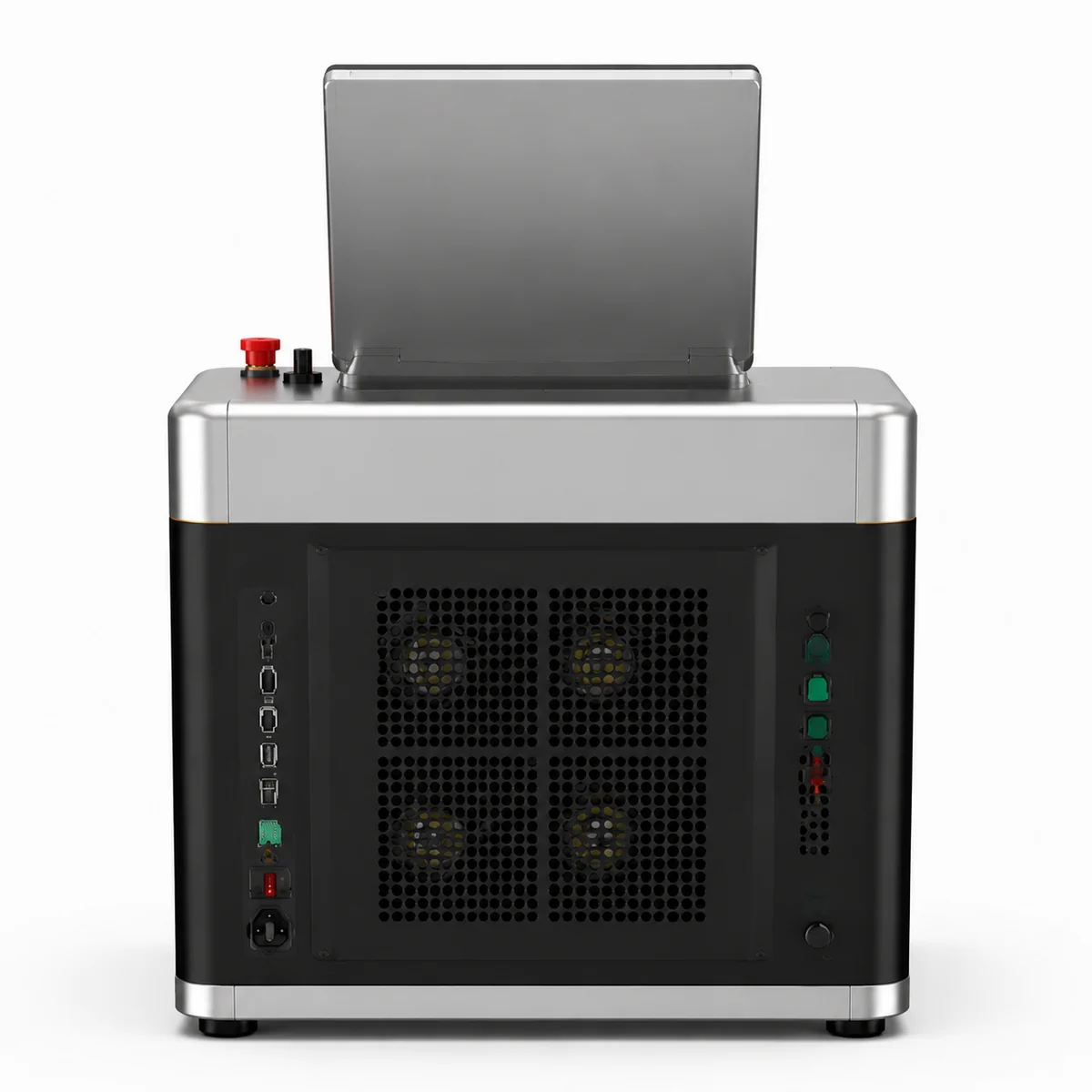
The rear vent wall that carries the whole heat budget behind these jewelry laser welder specifications
The rear panel is the vent wall. There is no second cooling unit.

The ambient rating comes off the same budget: 0 to 40 °C at 80 percent humidity or below. Air cooling is why that is a working range rather than a formality — an unconditioned back room in a hot climate falls inside it.

So does the maintenance line, empty on the water side because there is no water side. What is left is the protective lens.

WHAT IS NOT HEREAIR COOLED CABINET Pending · no water side

Machine

Part level

Component-Level Specifications

Some specification lines describe what the machine does. These describe whether it keeps doing it.

POWER STAGE Pending · IGBT

German Infineon IGBT

Decides whether pulse number one thousand matches pulse number one after twenty minutes of continuous high-power work. The cheap part and the good part read identically on any sheet that does not name a brand.

Constrains: pulse-to-pulse repeatability
MAINBOARD Pending · regulation stage

Voltage regulation stage

Its job is to keep the energy delivered from drifting between pulses, so that the pulse trialled on a test point is the pulse still being delivered at the end of a run.

Constrains: the 120–1200 W figure holding
QUARTZ · COATED Pending · quartz lens

Quartz optics, optimized coating

Against the K9 glass and ordinary coatings used elsewhere in this class. A durability specification rather than a performance one: how long a coating survives a working environment.

Constrains: the length of the consumable list
SWITCHGEAR Pending · switchgear

Schneider electrical components

The switchgear behind the single-phase supply row, where a failure is not a performance question but a day the bench does not open.

Constrains: what happens on a bad day

We build the laser power supply and the QCW fiber source ourselves rather than buying them in, which is why these rows can be specified at all instead of being whatever a supplier shipped that quarter.

How the machine is built

Machine

Over five years

Consumables, Source Life and Warranty

ONE ENTRY ON THE LIST Pending · protective lens M3LAMP-PUMPED Pending · one spare
Routine consumables
One entry: the protective lens, and changing it is bench work. A lamp-pumped machine in this class carries five or six entries, each on a different cycle, each one an order to place and a day the bench is not earning. Over five years that single line is worth more than any performance row above it.
Rated source life
Above 100,000 hours. Read the noun: it rates the source. It is not a figure for the machine and it is not a term of cover.
Warranty
Two years on the laser source, one year on the machine, with lenses and consumable parts excluded. The exclusion is printed here, in the specification, rather than left to be found in the paperwork under the lid.

When you set warranty columns side by side, check which of the other sheets carries the same exclusion somewhere less prominent.

Configurations and what ships

MOPA

Configuration

Optional Configurations

MOPA source 10 / 20 / 60 W

Specified against the pieces you make and the metal you make them in. We publish no recommended tier.

MOPA

Rotary device

Inside-band engraving is not possible without it, so it is standard kit for that work rather than an extra.

MOPA

Fume extraction

The same again for cutting: a day of thin-sheet work is not run without it.

MOPA

Cutting fixture

Holds thin sheet flat through the moment an outline breaks through, and belongs with any cutting configuration.

MOPA
INSIDE THE BAND Pending · rotary device EXTRACTIONFIXTURE Pending · extraction

Everything else on this page ships on every machine. The screen, camera, microscope, connectivity, air cooling, power stage and both laser sources are the machine itself, not a configuration level.

Machine

Two sheets side by side

Jewelry Laser Welder Specifications Against Two Benches

Three comparisons are worth making with another machine’s sheet beside this one, and one is not.

Published figures only
RowM3SISMA LM-DOrotig Evo X
Footprint300 × 340 × 320 mmroughly 600 × 840 × 610 mm
Weight30 kgabout 68 kgabout 41 kg
Cooling on the benchAir cooled, nothing standing beside it
Functions on one benchWelding, marking and engraving, cuttingWeldingWelding
Exclusions we printLenses and consumable parts, stated on this page

A dash means we hold no published figure for that cell. We would rather leave it empty than fill it from memory.

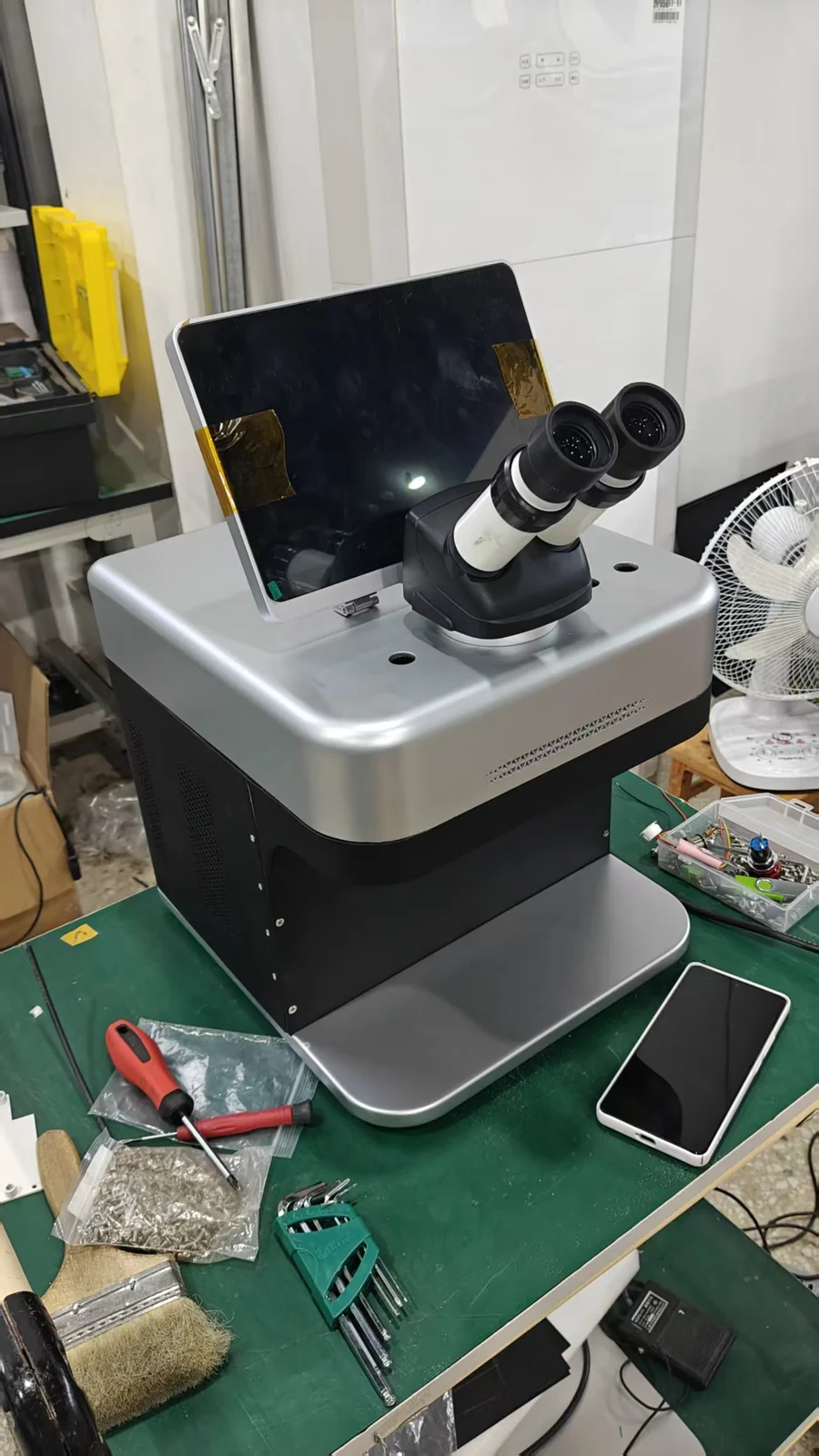
The M3 on a working bench beside a phone, the footprint row of these jewelry laser welder specifications shown against a real object
The footprint row, photographed rather than tabulated.

Compare the footprint including the cooling

The bench space a machine occupies is the cabinet plus whatever its cooling needs. Then compare function coverage, because it changes what you are counting: the European benchmarks are single-function welders, so marking and cutting on those benches are further machines with further footprints.

Then the exclusions: what the warranty leaves out, how many entries the consumable list really has, and what supply the machine asks for.

ONE BENCHTHREE BENCHES Pending · one bench THIS SHEETTHEIRS Pending · two sheets

We will not claim the M3 beats those machines on every welding parameter. What none of them does is put welding, marking and cutting on one 30 kg air-cooled bench unit, and that is the comparison this sheet is built to win.

Who the M3 suits

A sheet answers what a machine is rated for. Your own metal answers what it does on your work.

Send a Piece in Your Alloy

QCWMOPA

Sample work

Your Piece, Your Settings, Written Down

Four things to tell us

  1. The alloy and the karat you actually work in.
  2. The section, or the sheet thickness.
  3. The job itself — the joint, the mark, the outline.
  4. Whether marking or cutting is part of what you want the machine for.
ALLOY Pending · alloy SECTION Pending · section SETTINGS Pending · returned

What comes back

The piece, and the parameters used written down beside it, so you can read them against the jewelry laser welder specifications on this page rather than against a claim.

If you are specifying against another quotation, send the line items you need matched and we will answer them one by one against the figures above, including the ones we have left empty.

Ask against the sheet

Send Your Alloy and Your Line Items

Tell us the metal, the section and the job. If you are matching this page against another quotation, send the rows you need answered and we will answer them row by row.