Rotary device
Turns a curved surface under the beam. The standard configuration for a bench taking inside-band work.
M3 · MOPA fiber marking source
Built around what a jewelry counter actually sells: a date inside a wedding band, a logo on a pendant back, hallmarks and serial numbers on stock, colour figures on steel and brass.
The marking side
Red light walks the outline on the piece first, so the position on a band, a tag or a pendant back is confirmed rather than judged afterwards.
Artwork arrives in the formats a customer emails, a designer exports and a retailer sends as a brand asset:
They live on the machine’s own 10 inch 1280P Android touchscreen — no separate computer to buy, find bench space for and cable up. Bluetooth, Wi-Fi and USB all get a file onto it.
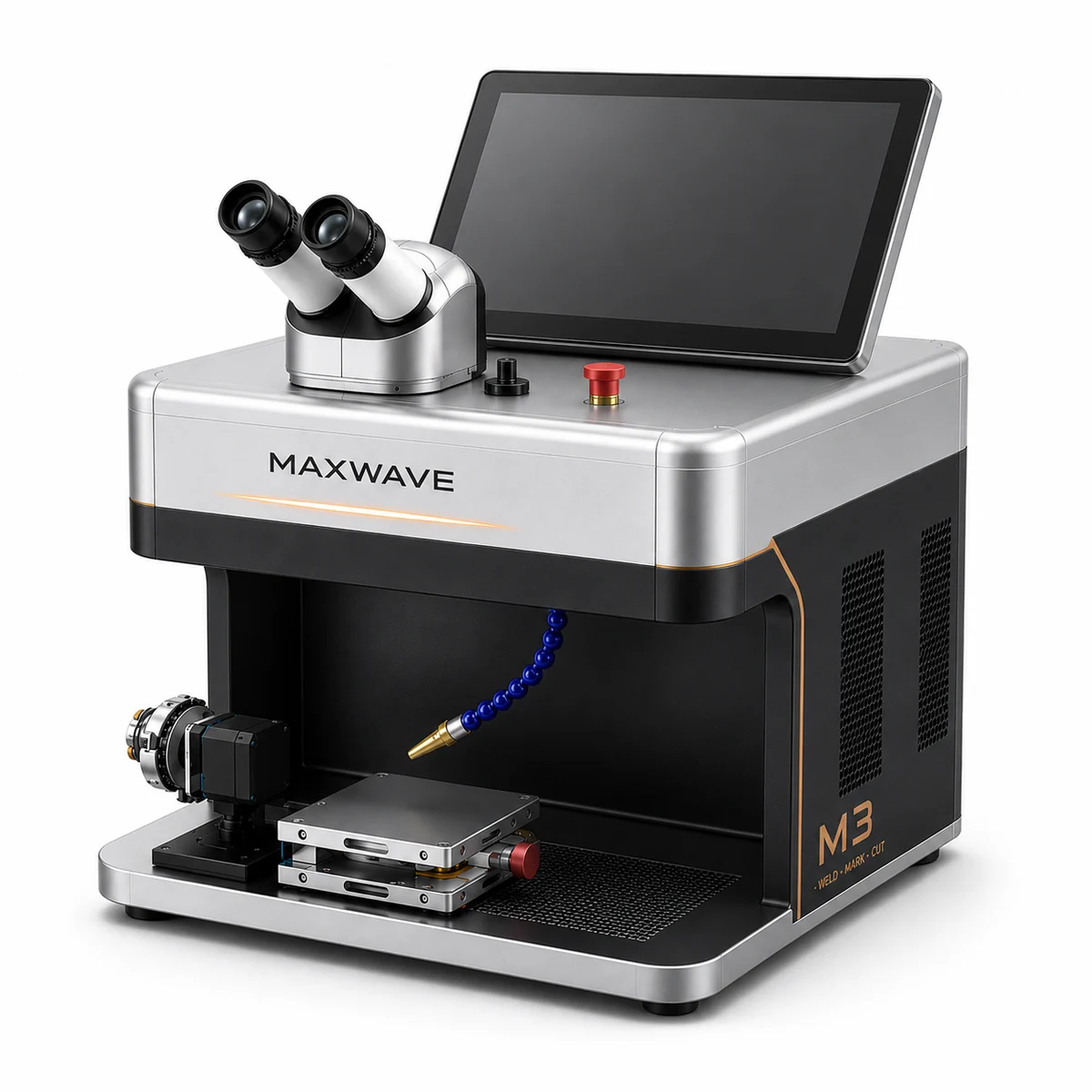
Turns a curved surface under the beam. The standard configuration for a bench taking inside-band work.
Holds thin sheet flat, which is what makes an outline cut repeatable rather than a one-off.
For a shop that marks and cuts through the working day rather than between repairs.
The job that decides it
Inside-band work is the most requested engraving job at a retail counter, and the one that decides whether a marking machine on your bench is useful or half useful.
A flat-field marker focuses on a plane. The inside of a ring falls away from that plane within a few millimetres of the centre line, so the beam is in focus for two or three characters and out of focus for the rest of the sentence. No setting fixes this.
On the M3 the band is held on the rotary device, the surface turns under the beam, and every part of the text is marked at the same focus. That is why we treat the rotary as the standard configuration for inside-band work rather than as an extra.

Pulse duration
A MOPA source lets the pulse duration be set, and that one control separates two completely different results on a finished jewelry surface.
A fixed-pulse Q-switched marker has no choice to make here.
It has one pulse. The only way it can produce a darker, more legible mark is to go deeper — which on a thin or already-sized shank stops being a cosmetic decision and becomes a structural one. On the M3 the choice is made per job, not built into the machine you are stuck with.
Where the burn lands
Text inside a band is small, because the band is narrow. A script font at that size has thin strokes, and a logo from a brand file has hairlines drawn to be printed rather than burned into metal.
Keeps the counters inside letters open at the size a narrow band actually takes.
A filled area is covered fast enough that heat does not build up underneath the fill.
The text is seen sitting where it will sit, at the size it will be, and moved before it is permanent.
When energy spreads sideways from where it was aimed, thin strokes thicken, the counters inside letters fill in, and a traced signature comes out as a smudge with the handwriting gone.
Putting the same energy in with a narrower heat-affected zone keeps the burn where the vector was. That is the second thing pulse control buys.
How we hand the settings overThe range, given up front
Given here rather than discovered after delivery. Pick a metal and read what comes off the bench.
Stainless steel and brass take colour — cheap blanks, high perceived value, and a result a customer cannot get from an engraving service down the road.
Both take flat marks and engraved grooves too, so one blank type covers a name tag, a branded disc and a colour figure.
Colour · mark · engraveAnodised aluminium marks black. A different result from colour, and quoted as a different job rather than folded into a colour price.
The right answer for high-contrast text on a light anodised finish: equipment plates, event tags, branded pieces.
Black mark · not colourGold, silver and platinum mark and engrave, no colour. That is the great majority of what crosses a jewelry counter, and it is served by the depth choice instead: a flat mark inside a band, a groove where the mark has to last, a hallmark on finished stock.
Silver is the exception. It reflects more of the beam than gold or steel, and it darkens over time in a way that changes how a mark reads a year later. A normal job — with its own settings rather than settings borrowed from the steel side.
Mark and engrave, no colourThe marking side also covers painted surfaces and hard plastics — gift work, watch parts and eyewear components, which arrive on the same day as the rings.
One machine takes the ring and the spectacle temple — the difference between quoting that order and sending it down the road.
Paint · hard plasticsWelding covers a wider list — gold, silver, platinum, titanium, copper, aluminium and steel, each loaded from its own preset.
Gold, silver and platinum weldingColour work
Set up once per blank type and per finish, signed off once, then repeated from a stored file and a written set of settings — not guessed at on each order.
Colour is signed off on the physical piece, never on a screen.
A display renders it under its own backlight; the metal renders it under whatever light is over the counter. Colour is also the most parameter-sensitive work the machine does: the same file on the same metal lands elsewhere if the alloy came from a different batch, if the blank is brushed rather than mirrored, or if it sits at a different height in the fixture. How the colour is produced
The bench method
This decides whether engraving stays an occasional favour or becomes income. Most of it is how the bench works, not what the machine has in it.
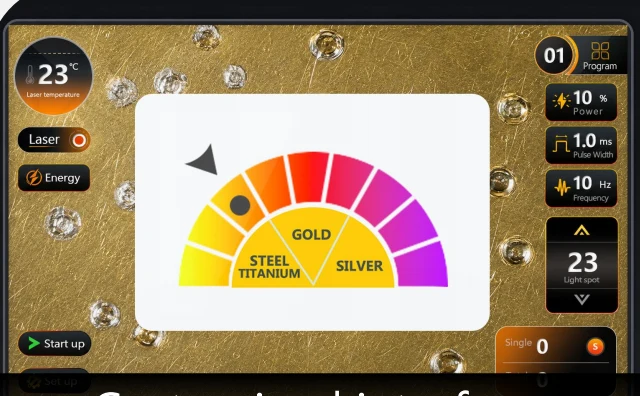
A one-press material preset that loads a starting point instead of zero, and file storage on the 10 inch screen so a job’s artwork is still there next month. Everything below is what the bench does with that — method, not a feature list.
Same metal, same surface finish. Never the customer’s piece and never an expensive blank.
The settings that produced the accepted result go down against that job. Thirty seconds of writing.
The tile is the sample the customer signs off, in the light they will see the piece in.
Tile, settings and artwork file go into the job folder as one thing, not three.
The second piece and the fiftieth run that stored set. Nothing is rediscovered.
The blank, then its surface finish, then the height it sits at, then the file. Four checks will find it.
Changing settings first will not find it, and that is the habit the recipe exists to break. None of this is exotic. It is the difference between a job you can quote from a folder and a job you have to rediscover at the bench every time it comes back.
Engraving revenue at a repair counter is zero until a tray of samples exists on that counter.
We mark your first trayWhere the hours go
Repair is quoted by the job, by eye, from experience. Marking has a different shape, and quoting it like a repair loses money both ways.
A single inside-band engraving is not a cheap job, and a batch of thirty is not thirty times one.
When we return your test pieces we mark which jobs were setup-heavy and which were run-heavy, and write the stored-file name next to each — so you know what to take at the counter and what to batch to a marking morning.
A repeat job with a stored file and written settings is a same-day job.
It can be run from the screen by a second person while the bench owner is welding — the point at which marking stops competing with repair for the same pair of hands.
Stock decisions
Repair carries no inventory: the customer brings the piece. Marking is the first time a counter has to hold stock and guess what sells.
The piece walks in. Nothing is bought ahead, nothing sits on a shelf, nothing is written off unsold.
That habit is what makes the first blank order either cheap or expensive.
Stainless steel and brass blanks are inexpensive, take colour, and photograph well enough to sell online as well as at the counter.
Tags, discs, bar pendants and cuff plates cover most requests. Precious metal blanks tie up capital and are better ordered against a taken order.
Start narrow, and in the metals that do the most visible work.
Thin-sheet cutting on the same sourceBefore the machine is switched on
A mark on a customer’s own piece is permanent and visible, which makes it a different assessment from a weld. Four readings are taken, and any one of them can move the mark onto a blank.
A mark through rhodium or gold plate breaks the surface in a way that shows against the plating around it.
The inside of a band that has already been sized down has less metal in it than it looks like it has.
An existing hallmark or an old hand-engraved inscription sets where a new mark can sit.
An heirloom with an original maker’s mark is not a blank. Removing or crowding that mark is not something to discover afterwards.
Where any reading says no, we say so, and the usual answer is to put the mark on a blank that goes with the piece rather than into it — a charm, a tag or a plate.
Repeat orders, sold locally
Consumer engraving fills the hours between repairs. Trade work turns it into a line on the books — every one of these is a repeat order against a stored file.
All of it belongs to whoever can show the same result twice, rather than to whoever is cheapest.
Who the M3 suitsWhat is specified

One cabinet.
MOPA marking source and QCW welding source, sharing the same bench footprint.
| Item | What is specified |
|---|---|
| Marking source | 10 W / 20 W / 60 W MOPA — chosen at order against the work you take. |
| Rotary device | The standard configuration for inside-band work — optional on the list, not optional on the job. |
| Cutting fixture | Holds thin sheet flat. The standard configuration for cutting work, for the same reason. |
| Fume extraction | For a bench marking and cutting through the working day. |
| Warranty | Two years on the laser source, one year on the machine. Lenses and consumable parts are not covered. |
| Routine consumable | The protective lens. Replacing it is bench work, not a service call. |
| Rated source life | >100,000 h on the fiber sources — a source rating, not a machine life or a warranty term. |
| Operating videos | Inside the machine, on the screen used to run it, in Chinese and English. Other languages on request. |
The first tray is on us
Tell us the engraving request that crosses your counter most often, and send one piece or blank with it.
A counter display, not a brochure. A customer picks a piece up, turns it over, and asks what it would cost on theirs.
Start with one pieceSend your piece
Tell us the request that crosses your counter most often. It comes back marked, with the settings written down.