M3 · Who it suits

A Jewelry Laser Welder for Repair Shops, Built for the Whole Tray

A band to size up. A chain with a broken link. A claw to retip with the stone still in. A pendant that wants a date inside. A sheet blank waiting to be cut.

The M3 is built for that tray. A jewelry laser welder for repair shops, goldsmiths, studios and sample rooms: QCW welding, MOPA marking and cutting, one air cooled cabinet.

300 × 340 × 320 mm · 30 kg · AC 220 V single phase · 2 kW
This morning’s trayTick what is on yours
TRAY / 5 JOBSPending photo · the morning tray
The day closest to your tray lights up below.

Three sets of work

Jewelry Laser Welder for Repair Shops: Three Jobs

Three sets of work cross this jewelry laser workstation in a day. The four days that follow are different mixes of the same three.

QCW source · 120–1200 W

SEAM / SPOT BY SPOTPending photo · sizing seam at 10X

Welding

  • Sizing up and sizing down
  • Chain and jump ring repair
  • Claw and prong retipping, stone in place
  • Porosity and pit filling
  • Snapped posts, findings, bezels, hinges, catches

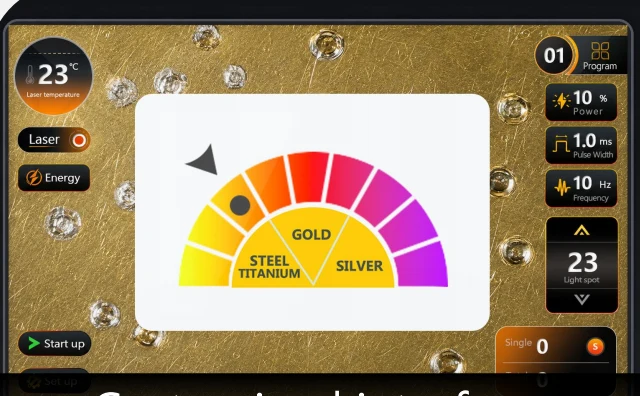
Gold, silver, platinum, titanium, copper, aluminium and steel each start from a preset. Spot, pulse width and frequency are trimmed once the first shot is read under the microscope.

Repair work in detail
MOPA source · 70 × 70 mm field

INSIDE BAND / ROTARYPending photo · date inside a band

Marking

  • Names, dates, initials, messages
  • Logos and serial numbers
  • Hallmark-style identification
  • Inside a band, on the rotary device
  • Pendants, tags and blanks, flat in the field

A curved inner surface has to turn under the beam, so band work runs on the rotary device. Artwork arrives as PLT, DXF, AI, BMP, JPG, PNG, TIF, CAD, CDR or DWG.

Engraving and marking

MOPA source · cutting fixture

THIN SHEET / OUTLINEPending photo · name necklace off the sheet

Cutting

  • Name necklaces
  • Tags and letter pieces
  • Small metal graphics
  • Thin sheet outlines
  • Same file cuts, then places the mark

The cutting fixture holds thin sheet flat and fume extraction takes the smoke off the bench. That list is what has been put through it, and the list stops there.

Thin-sheet cutting

The three sets never arrive in separate weeks. They arrive mixed, in whatever order the door opens. That is the whole reason for putting them in one cabinet.

Day 01 · welding-led

A Day on a Goldsmith’s Own Bench

One operator, nobody to hand anything to. Work arrives from two directions: trade repairs sent in by shops with no bench of their own, and pieces made under the goldsmith’s own name. This is the jewelry laser welder for goldsmiths who do both.

QCW weldingMOPA marking

Morning
01

The dial is where it was left

GOLD, STEEL, TITANIUM and SILVER sit on the material dial. The trade work that came in overnight is mostly the first of those, so one touch loads the preset and the bench is working.

QCW · GOLD preset
Morning
02

Trade repairs first

A karat band is held and focused under the binocular microscope. The seam is built with the spot toward the fine end and the pulse short, one pedal press at a time, until the band polishes round with no step.

Spot fine · pulse short
Midday
03

Silver, then platinum

Silver carries heat out of the joint faster: a preset change and a trim, not a different machine. Platinum, copper and aluminium start from the nearest position and are corrected on the first shot.

Preset changed · trimmed by eye
Midday
04

Own making in the gaps

A bezel closed. A jump ring run. A finding attached to a piece soldered everywhere else. The assembly joints of new work ride in between the repairs without a change of set-up.

QCW · same head
Afternoon
05

The head changes once

Pieces going out under the maker’s name are signed inside the band. That is the rotary device and the marking interface, so every band that wants engraving has been waiting for this block.

MOPA · rotary device
End of day
06

The tray empties

Welding led, marking closed the day, and the head changed exactly once. The dial is left on whatever the first job tomorrow will want.

Dial set for tomorrow
PEDALPending photo · band sized under the microscopeSIGNED / END OF DAYPending photo · bands signed inside

Welding-led, one head change, a short block of marking at the end. How each alloy family behaves at the weld, and how the presets are trimmed for it, is on the precious metals page.

Day 02 · promise-led

A Day Behind a Repair Counter

The constraint is the front of the shop, not the bench. Work is taken in over the counter with a promise attached, and the promise is what the customer is buying. The M3 is the jewelry laser welder repair shops use to keep that promise inside the building.

QCW weldingMOPA markingQCW welding

Morning
01

The counter’s tray

A chain parted at the clasp. A ring to size. A claw that dropped its stone back into the setting. Earring posts snapped level with the back. A locket hinge that no longer closes.

Taken in · promised
Morning
02

Jobs that used to leave

Each piece is held, focused and welded where the microscope was focused. The pedal does the firing, so both hands stay on the work and the job never goes out to a trade bench.

QCW · pedal fired
Midday
03

The customer watches

The 10 inch 1280 P touch screen carries the microscope view in colour from the 8 megapixel camera, at a size somebody across the counter can see. The repair happens in front of its owner.

Screen facing the counter
Midday
04

Stone-set work is assessed

Stone species, treatment, setting structure and the distance from weld to stone decide whether a piece is worked as it stands or the stone comes out first. Nothing fires before that call.

Assess · then fire
Afternoon
05

Counter stock gets marked

Blank tags and pendants take names and dates for the personalization sold across the same counter. That is a change to the MOPA head, in the gaps between repairs.

MOPA · flat in field
End of day
06

Gather, or keep the promise

Marking is gathered into one block and the head changes once. When a customer is collecting soon, the promise beats the efficient routing, and the head changes again. The counter makes that trade knowingly.

One change, or more
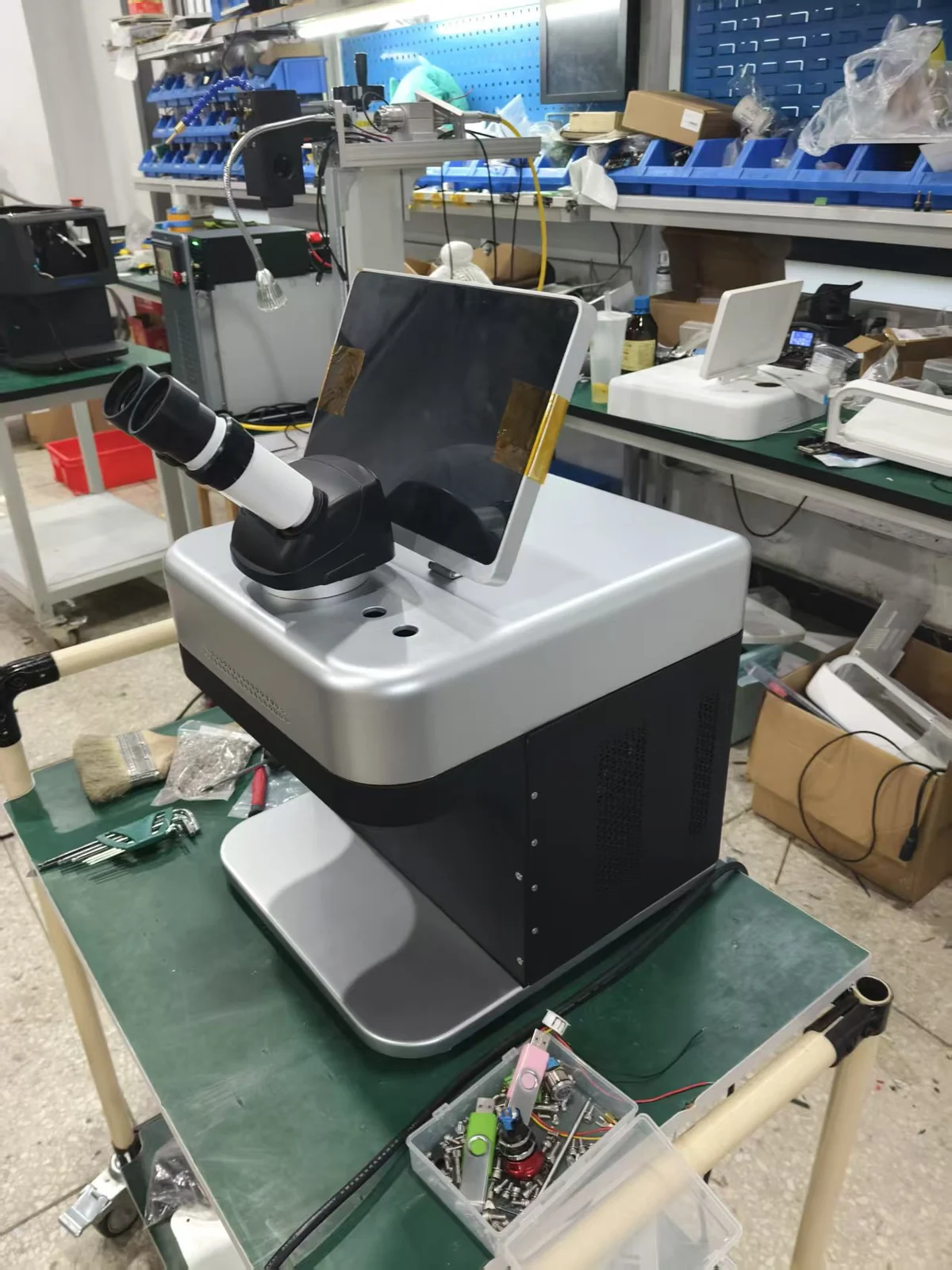
Jewelry laser welder for repair shops: the M3 with its screen lifted toward the customer opposite
The M3 on a working bench. The lifted screen is what the customer sees.
10 INCH / LIVE VIEWPending photo · repair shown on the screen

Promise-led, welding through the day, marking gathered where the promises allow. Assessment, holding, the first pulse and stone-set work are covered in full on the repair page.

Day 03 · making-led

A Day in a Personalization Studio

The direction of the day is reversed. Making leads, and welding sits at the end. For a small business selling names, dates and charms, this desktop jewelry laser welder starts the morning as a cutter.

MOPA cutting + markingQCW welding

Morning
01

Artwork is checked first

Customer files are read for whether they can be cut at all: connected strokes, islands still attached to something, and a hanging hole placed where the finished piece will balance.

MOPA · file open
Morning
02

Sheet goes on the fixture

A fine stroke lifts at the moment the outline breaks through, and a lifted stroke is a lost blank. Red light walks the outline on the actual sheet, extraction runs, and pieces come off the bed to be edge-checked.

Fixture · extraction on
Midday
03

The same source marks the cut

Initials, dates and small logos go on flat within the field at 0.01 mm marking accuracy. The file that cut the outline places the mark on it. Stainless steel and brass take colour; anodized aluminium marks black.

MOPA · 70 × 70 mm
Afternoon
04

One change, other direction

The head changes once, from MOPA to QCW: the opposite trip to the goldsmith’s. Everything cut and marked today is already waiting in a tray for it.

MOPA → QCW
Afternoon
05

Welding comes last

Jump rings closed on cut charms, a bail attached, a clasp fitted, a chain welded closed on a wrist for a permanent piece. The piece never has to go anywhere to be joined.

QCW · pedal fired
End of day
06

Finished stock, not an empty tray

What is left on the bench is sellable stock. The welding source is the reason a studio that came for cutting stays.

Stock on the bench
RED LIGHT / BEFORE THE CUTPending photo · red light on the sheetFINISHED STOCKPending photo · charms joined, end of day

Making-led, one head change in the opposite direction, finished stock at the end. Artwork, holding and breakthrough are on the cutting page; chains welded on the wrist are their own page.

Day 04 · procedure-led

A Day in Aftersales and the Sample Room

In a small factory this bench serves nobody standing in front of it. It serves a production line on one side and a design desk on the other, and both halves run on written parameters.

QCW weldingMOPA marking + cutting

Morning
01

Returns and warranty pieces

Aftersales work is the same joint on the same model, seen again and again. The job is to weld the second piece the way the first one was welded.

Job sheet open
Morning
02

The same joint, repeatably

The preset is loaded by material. The spot is set electrically rather than by feel. Pulse width and frequency are the ones on the job sheet, so the repair holds for whoever is on the bench that shift.

QCW · recorded values
Midday
03

Identification goes back on

Serial numbers, batch identification and the shop’s own reference are marked where they will not show on the finished surface, including what polishing took away.

MOPA · identification
Afternoon
04

A file becomes a sample

A model that exists only as a file gets its outline cut from sheet, marked and joined. The design desk has something to hold rather than something to look at.

Cut · mark · join
Afternoon
05

The design changes

The next version is cut from the same sheet stock on the same bench, and the change is in the hand the same working day.

Same stock · same bench
End of day
06

The parameter sheet

Material
preset
Spot
set electrically
Pulse width
written
Frequency
written
Kept beside the machine
PIECE 01PIECE 02Pending photo · same joint, second piecePending photo · sheet next to the machine

Procedure-led: written parameters on both halves of the day. The complete parameter list for both sources is on the specifications page, and the people who build the machine are on the about page.

One job, four routings

One Ring, Four Benches, Four Routings

A single karat band, to be sized up with a date engraved inside it. The machine does the same two operations every time. What changes between benches is the route the job takes to reach them.

SEAMDATEPending photo · the band, sized and dated
The jobGoldsmith’s benchRepair counterStudioSample room
First operationSized under the microscopeSized, quoted with a date on itMarked inside first, while the file is openSized with the recorded parameters
ThenWaits with the other bands for the marking blockEngraved straight after if collection is soon, otherwise joins the blockSized afterwards on the welding sideIdentification that was polished away is re-marked
Head changesOnce, late in the dayMid-job when the promise demands itOnce, in the opposite directionAs the procedure lists them
Decided byThe benchThe promise made at the counterThe order: engraving is the saleA written procedure, then recorded

Four benches, one machine, four routings. The routing that reads like your own shop is the day to read again.

Changing heads

Two Heads, One Cabinet, No Shared Datum

The M3 carries two heads in one cabinet under one screen. The QCW welding head works through the binocular microscope and the camera. The MOPA head is a galvo head running at 7000 mm per second across the 70 × 70 mm field. They do not share a datum, and that single fact shapes all four days.

  1. Off the welding positionMoving between sources is a physical operation, not a menu selection. The piece comes off.
  2. Held again on the marking sideThe piece is set up for the MOPA head as its own job, in its own holding.
  3. Red light walks the outlineOn the metal in front of you, at the size it will be, where the mark or the cut will land.
  4. Confirm, or hold it againA crooked piece is re-held, never compensated in the file. The next piece will sit crooked differently.
Carries across

Parameters

  • The welding preset for a metal
  • The marking recipe for a job run before
  • Settings on a repeat customer’s job sheet

Stored once, recalled on demand, identical on the hundredth piece.

Does not carry

Position

  • No shared origin between the heads
  • No position kept through a head change
  • No file edit standing in for holding

Every trip ends with the red light confirming where the beam lands.

Gather the marking into one block and the set-up is paid once.

A head change costs a set-up. Scatter marking through the day and it is paid every time. The goldsmith’s day and the studio’s day both pay it once, from opposite ends. The repair counter is the bench that cannot always gather, and it knows why.

The return: a piece never leaves the bench. Sizing, inside engraving and the tag that goes with it are done by one person in one place, and work that used to come back on a subcontractor’s schedule comes back on yours.

Both sources, full parameters
RED LIGHT / ON THE PIECEPending photo · red light on the actual piece

Every working day

Switch On, Read the Dial, Switch Off

No chiller to fill, plumb or bleed: the M3 is air cooled. No computer to boot: the 10 inch capacitive touch screen runs Android and both interfaces live on it.

Material dial of the jewelry laser welder repair shops start each job from: GOLD, STEEL, TITANIUM, SILVER
The material dial as it appears on the screen.
  1. Switch onSingle phase AC 220 V, 50 Hz, 2 kW. Choose welding or marking on the screen.
  2. Read the dialGOLD, STEEL, TITANIUM, SILVER. One touch loads the preset. Spot 0.1–2.0 mm set electrically, pulse width 0.2–15 ms, frequency 1–20 Hz.
  3. Trial shot at 10XOn an unfamiliar alloy the first shot is read under the binocular microscope. On platinum, copper or aluminium it does the work the dial cannot.

The only part a day consumes is the protective lens. Operating and maintenance videos sit on the same screen, which is where a second operator learns. Shutting down is switching off.

Training and support
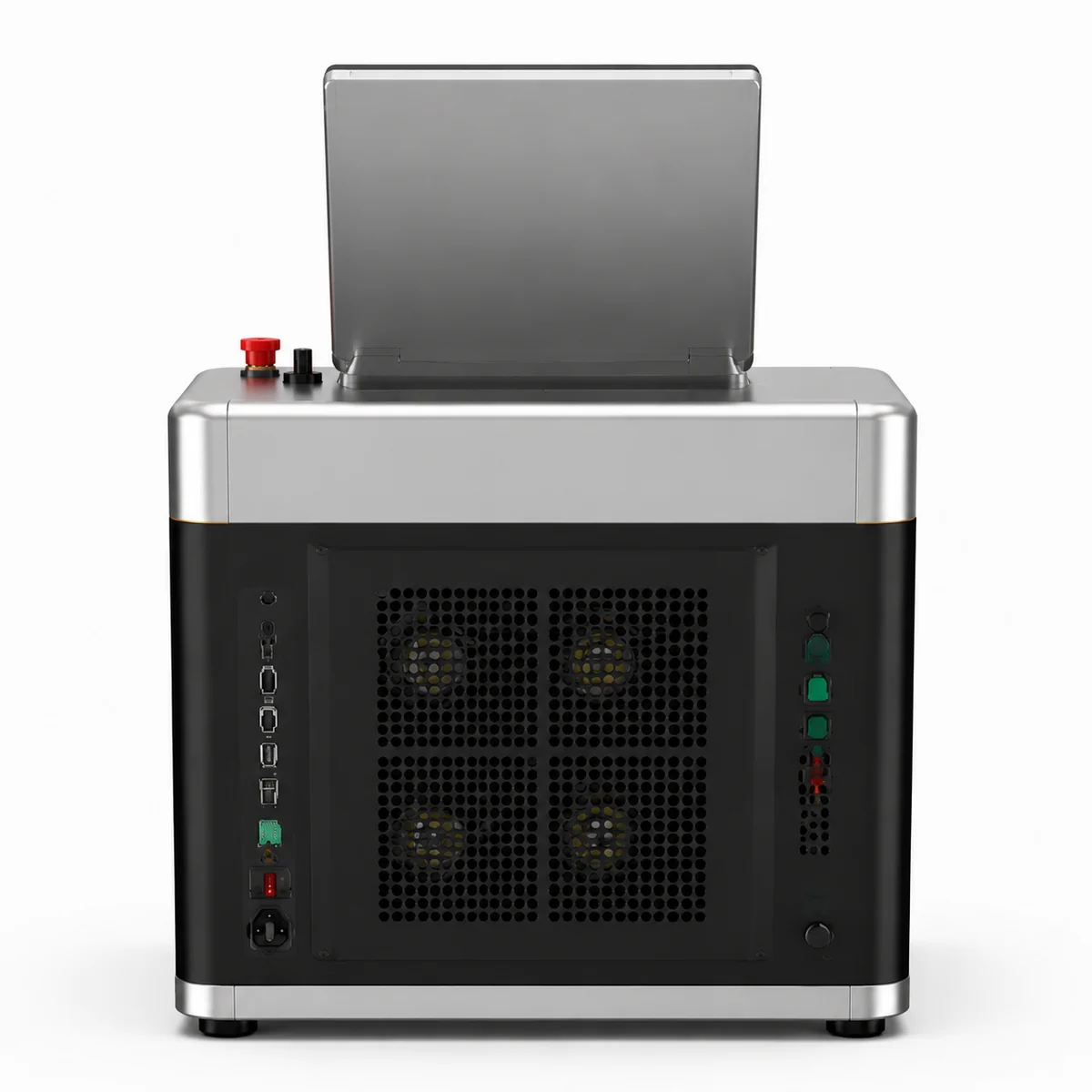
Rear air cooling grille of the M3: fans in place of a chiller
Pending photo · trial shot, read firstPending photo · the one consumable

Footprint

Footprint: Jewelry Laser Welder for Repair Shops

With a compact goldsmith laser welder this size, the question stops being whether there is room for a laser. It becomes where on the bench it goes.

300 × 340 × 320mm

30kg · lifted by one person

Pending photo · bench corner

A corner of the goldsmith’s bench

It takes a corner of the working surface and leaves the rest of the bench as a bench. One person lifts it, which matters in a workshop that gets rearranged.

Pending photo · behind the counter

Behind the repair counter

Often the only space is behind the counter itself, in sight of customers. A machine that stands on the counter surface and runs from an ordinary single phase socket is a different proposition from a floor-standing unit with a chiller beside it.

Pending photo · studio table

Sharing the studio’s sheet table

It shares a table with the sheet stock, the fixture and the extraction. The constraint is clear working room around the field, not the footprint of the machine.

DESKLINEPending photo · carried to the line

Moved to where the work is

Next to the design desk one month and next to the line the next, without an installation. Air cooled, no chiller, one plug.

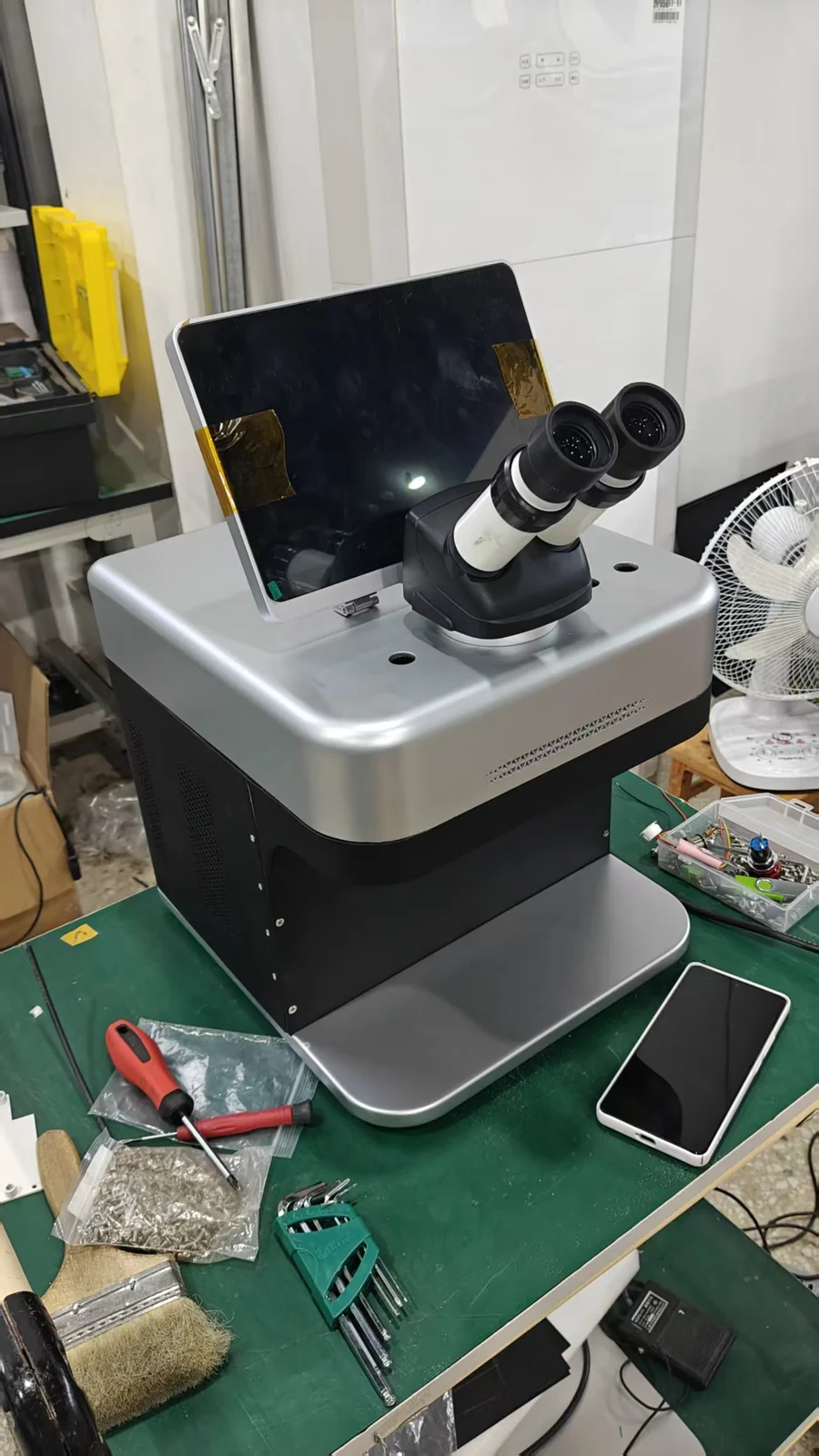
Jewelry laser welder for repair shops, shown to scale: the M3 on a bench with a phone beside it

A phone beside it for scale. Renders cannot prove a footprint; this photograph can. The same cabinet holds the QCW source, the MOPA source, the microscope, the camera and the screen.

Compared with other compact benches

The edges, stated plainly

Working Limits: Jewelry Laser Welder for Repair Shops

The four days are benches where work arrives one piece at a time and each piece is judged before it is fired on. That is the shape of day this machine is built around, and it has edges.

The edgeWhy it is thereWhat gets said
Single-piece rhythmHeld by hand, fired by pedal, the joint read at magnification between shots. The same joint run continuously through a shift belongs to fixtured, automated equipment.If that is the volume, the answer is a line machine, said before the quote.
Spot 0.1–2.0 mmThe welding spot is set electrically inside that range. Finer spots exist on other equipment.Work whose whole difficulty sits below the range is named as below the range.
Field 70 × 70 mmA piece larger than the field is not one set-up. Cutting is thin sheet: name necklaces, tags, letter pieces, small metal graphics, sheet outlines.Past that list the answer is a trial on your own material, not an estimate.
Limits by metal are not publishedMaximum weldable section, minimum piece and sheet thickness do not hold still across the alloys a bench actually works in.Your piece is run and sent back with what it took, written down.
No shared datumTwo sources in one cabinet cost a re-hold on every trip between them. The changing heads section spells that cost out.Gather the marking, pay the set-up once.
A week that is a tray of pieces judged one at a time meets none of these edges.
Pending photo · sample back, settings written70 × 70 MMPending photo · the field, actual size Ask about an edge case

Configuration

A Week of Work, a Configuration Sheet

The four days do not ask for the same machine. The differences sit in the accessories, not in the cabinet.

What a week gets mapped onto

  • Proportion of welding to marking to cutting
  • The largest piece handled
  • Whether rings are engraved inside
  • Sheet cut daily, or occasionally
  • How many hands will be on the machine
MOPA source
10 W / 20 W / 60 WDecided by what is being marked and cut, not by a tier.
Rotary device
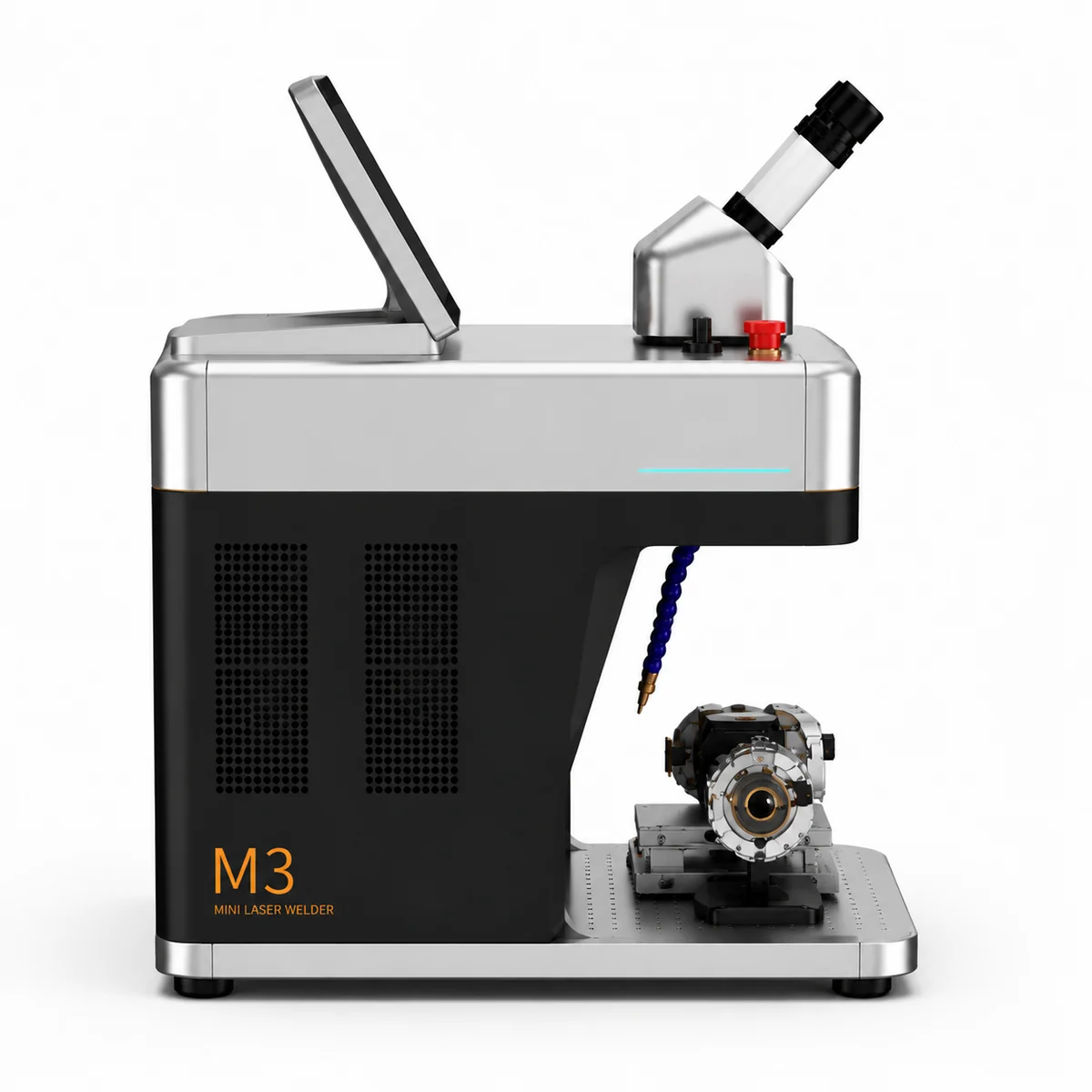
Standard kit for inside-band workA curved inner surface has to turn under the beam. Any day with rings engraved inside has it on the sheet.
Cutting fixture + fume extraction
Standard kit for a cutting dayThe fixture holds sheet flat, extraction takes smoke off the bench. Usually unnecessary at a pure repair counter.
Mains supply
Its own row on the sheetState the single phase voltage and plug pattern of the shop. It is settled before anything ships, not after it arrives.
The M3 from the side with the rotary device fitted for inside-band engraving
Pending photo · a filled configuration sheet

Four benches, one machine, four routings.

Find Out Which Day Is Yours

Send a week

Send Us a Week of Your Work

List what crossed your bench in one week. The reply names which of the four days your week looks like, the configuration that day asks for, and what it does not need.

  • What came in
  • Roughly how it split: welding, marking, cutting
  • Which jobs currently go out
  • The largest piece handled

Prefer the answer in metal? Post a piece. It is run on an M3 and sent back with the settings written down.