Name necklaces
An outline with no straight line in it. Letters join along the baseline, stroke width shifts along its own length, and the hanging points go where the name balances rather than where the drawing ends.
M3 · MOPA fiber cutting source
A 300 × 340 × 320 mm bench machine at 30 kg, air cooled, with no chiller to plumb in. Cutting and marking share one 70 × 70 mm field, and the welding source sits in the same cabinet.
Layout shown at field scale. Red light walks the outline on the blank itself before anything fires.
Verified cut work
Five kinds of piece have been through this machine and can be shown cut. They are one job seen five ways, which is why one machine covers them.
An outline with no straight line in it. Letters join along the baseline, stroke width shifts along its own length, and the hanging points go where the name balances rather than where the drawing ends.
A simple perimeter judged entirely on its edge, plus one decision that cannot be undone later: where the hole sits. A tag is mostly edge.
Single characters cut as initials, monograms and charm sets, usually a run of the same character offered in a set of sizes.
Logos, symbols, hearts, pet silhouettes and club emblems. The artwork arrives as somebody else’s file and has to be made cuttable before it is anything else.
The shapes you cannot buy: a blank in your own proportion, a bar in your own length, a plate shaped to sit against a piece you already made.
Every one of them is thin sheet, cut to an outline, then marked, drilled or welded before it is a finished piece.
Marking the piece you just cut Charms for permanent jewelryWorking envelope
Seventy millimetres square is a nesting area for this class of piece, not a ceiling. The practical question on the bench is how the blank gets laid out, not whether the piece fits.
Time and attention in a cutting job go into the set-up, not the cut.
The blank goes into the fixture once. Everything laid out inside the field is cut from that one position: a row of initials, a name plus the spare letters you know will be asked for, a tag and the emblem that goes on its back.
Changing blanks is handling. Changing set-up is a job.
The MOPA source marks in this same 70 × 70 mm field, at 0.01 mm accuracy, at the same working height, referenced to the same origin.
A piece cut in that field is already in position to be marked in it, so a serial number goes on the back of a tag without the piece being lifted and re-aligned on another bed.
One blank, one clamp, one field, as many pieces as the layout holds. That is the smallest unit of planning on this bench.
Standard kit for cutting work
The cutting fixture is the standard kit for cutting work on an M3. It is listed as an accessory, and for marking work it genuinely is one — but nobody cuts sheet on this machine without it.
What it does is hold the blank flat and hold it down, across the whole area being cut, for the whole duration of the cut.
Sheet arrives with a memory of the coil it came off and is rarely dead flat out of the packet. A blank high in the middle by a fraction is cut at one setting on the edges and another in the centre: through in some places, holding on in others, discovered when the piece will not come out.
Fume extraction is the other half of the standard kit. Cutting removes metal, and what is removed has to go somewhere other than back onto the blank, onto the lens and into the room you work in.
The failure point
A cutting job does not fail at the start. It fails in the moment the outline finally goes through, and that is what separates cutting from marking on the same machine.
Up to that moment the blank is one piece of metal and the fixture is holding all of it. The instant the outline closes, the piece inside it is attached to nothing.
Marking never has this moment. The piece it works on is the piece it started with, still in one piece at the end. Cutting ends by producing a loose object, and every decision before that point is about what happens when it becomes one.
The piece settles a fraction and the last of the cut lands on the piece rather than on the line. What turns up afterwards is a mark across an edge that was already finished.
The edge nearest the last cut rises and the pass finishes across the face instead of along the outline. On a plated blank that mark goes straight through the plating.
The piece moves a fraction and the outline closes in the wrong place. On script lettering that is the difference between a joined name and a handful of loose letters.
The fixture keeps the blank down through all of it, so the only thing that changes at break-through is that the piece is free — not that the piece has moved.
This is the part of cutting that is learned rather than specified, and it decides whether a cursive name comes off the bed in one piece.
Off the bed
When the cut is done the blank comes out of the fixture as a set of parts, and there is an order to taking it apart.
The small islands from inside letters, and from any enclosed shape in a logo, come off the bed before anything else.
They are the pieces most likely to be lost.Each piece is lifted clear of the skeleton rather than pressed out of it.
Pushing a thin piece against the blank it came out of is how a fine stroke bends.On a run of initials the skeleton stays on the bench until every piece has been looked at.
It is the record of where each piece came from.Tabs come off next and are dressed back to the outline, positioned where the next operation covers them: under the jump ring, behind the bail, on the edge a setting hides.
Tab position is chosen in the artwork.Through evenly all the way round, fine strokes holding their width, and how much the finishing step will have to take off.
That reading is fed back into the settings for the next blank.The edge is what the customer sees on a name necklace. Reading it at the same bench, before the piece goes anywhere, is why the first piece of a new job is cut, looked at, and then cut again.
Files that cut
Most cutting problems are artwork problems, visible in the file long before they are visible in metal. A cut outline is a physical object, which imposes conditions a printed version never had to meet.
In a script name the letters must actually join along the baseline. Two shapes that touch at a single point on screen become two separate pieces of metal.
Every enclosed area is an island that falls out of the blank and has to be planned for. Fine on the counter of an o; a different job when a logo has forty of them.
Hairlines drawn to be printed have to be given real width. A stroke below what the metal can hold does not survive polishing.
Placed where the piece hangs the way it is meant to, sized for the jump ring going through it, far enough from the edge that the metal between hole and outline is not the weakest thing about the piece.
Open paths, duplicated outlines and text never converted to curves get resolved before they become cut instructions. A photograph of a signature is a conversation to have before the sheet is in the fixture.
One set-up
The piece is cut in the 70 × 70 mm field.
Turned over in the same field, the MOPA source marks the back.
The QCW source in the same cabinet welds the jump ring on.
One person owns the piece from file to finished.
A name wanted a size bigger is one blank re-cut, not three suppliers renegotiated.
First physical piece
Custom work is not sold from a drawing. It is sold from a piece somebody has held, and the first physical piece is where a custom order is actually decided.
Those changes go into the file, and a second piece is cut from the same blank stock at the same set-up.
A proofing round that runs through a subcontractor is measured in shipping, which is why so much custom work gets sold from renderings and then argued about after delivery. A proofing round on your own bench is measured in the time it takes to re-cut one blank.
You can afford to run the loop twice before you quote, and once more before you run the order.
Signed-off record
The first piece of a design is the expensive one. Everything after it should cost almost nothing to set up, and whether it does is decided by what was kept.
Called back together, the six make it so. Called back partially, they do not: a file without the fixture position means finding it again, and a file without the reference piece means nobody can tell whether the tenth is right.
That is what turns one-off custom work into stock you can sell twice. A letter set cut once is a set you can offer in a range of sizes forever, and the emblem made cuttable for a club is the emblem you cut again for their next order.
It also changes who can run the work: a signed-off record is a job somebody else in the shop can run from the screen, against a reference piece they hold up to what came off the bed.
Where the list ends
That is the list because that is what has been through the machine. A short list that is true beats a long one that is a guess, and anything outside it gets answered with a piece rather than a claim.
Pending photo · one of each, cut on an M3On this class of work a single number would mislead. The answer depends on the metal you use, on how your sheet was rolled and annealed, on how fine the finest stroke in your artwork is, and on which configuration the machine is built in.
A figure that is true for a plain tag in one metal is not true for a script name in another, and quoting the flattering one is how equipment gets sold and then disappoints.
So the answer given instead is a physical one: send the artwork and a piece of the sheet you actually work in. If your piece needs a different configuration, you hear that before you buy rather than after.
Pending photo · sample back, settings beside itA cutting sample costs a file and a piece of sheet.
Start a cutting sampleWhat to send
The more of this that comes with the piece, the closer the sample is to the job you actually run.
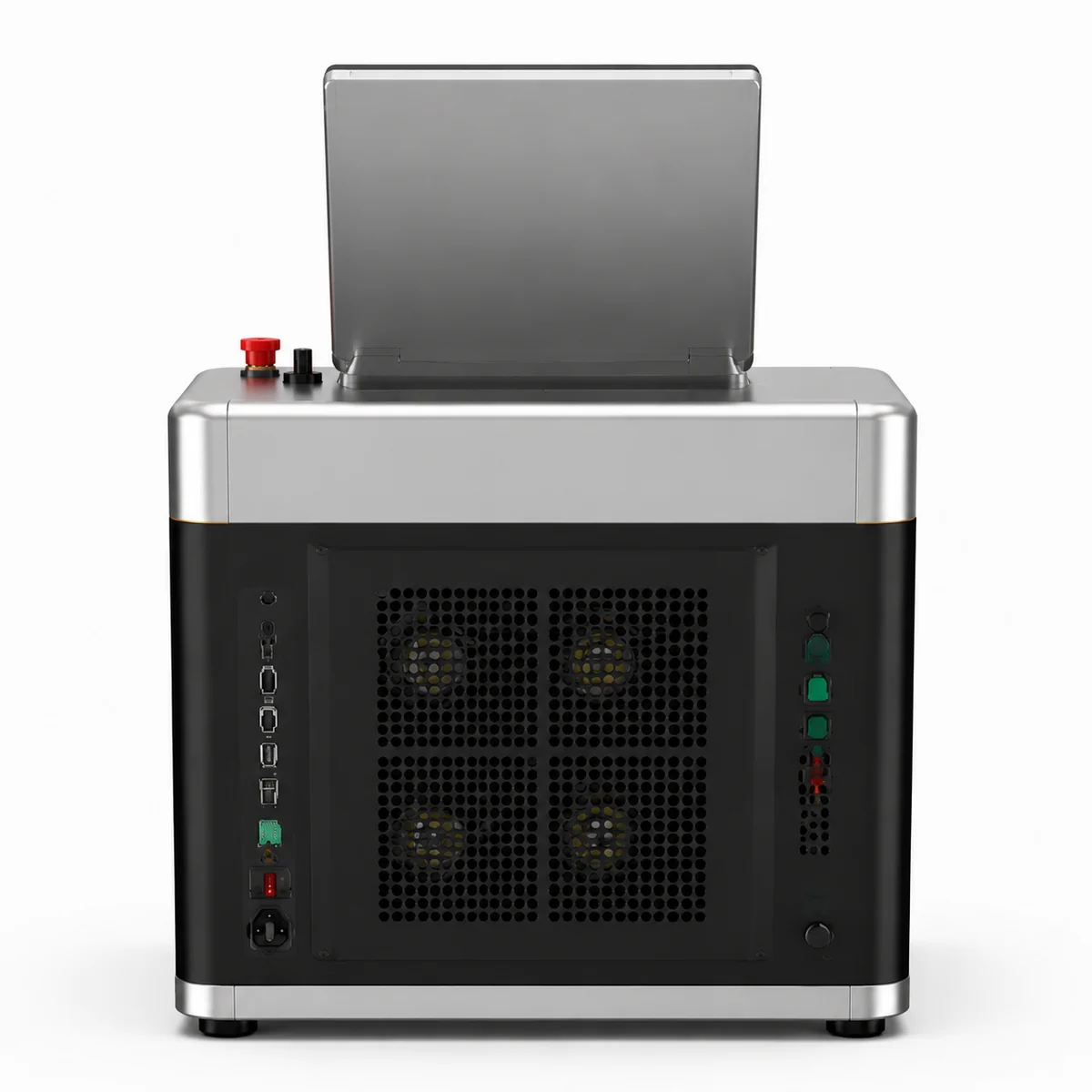
Air cooled. Nothing to plumb, fill or maintain.
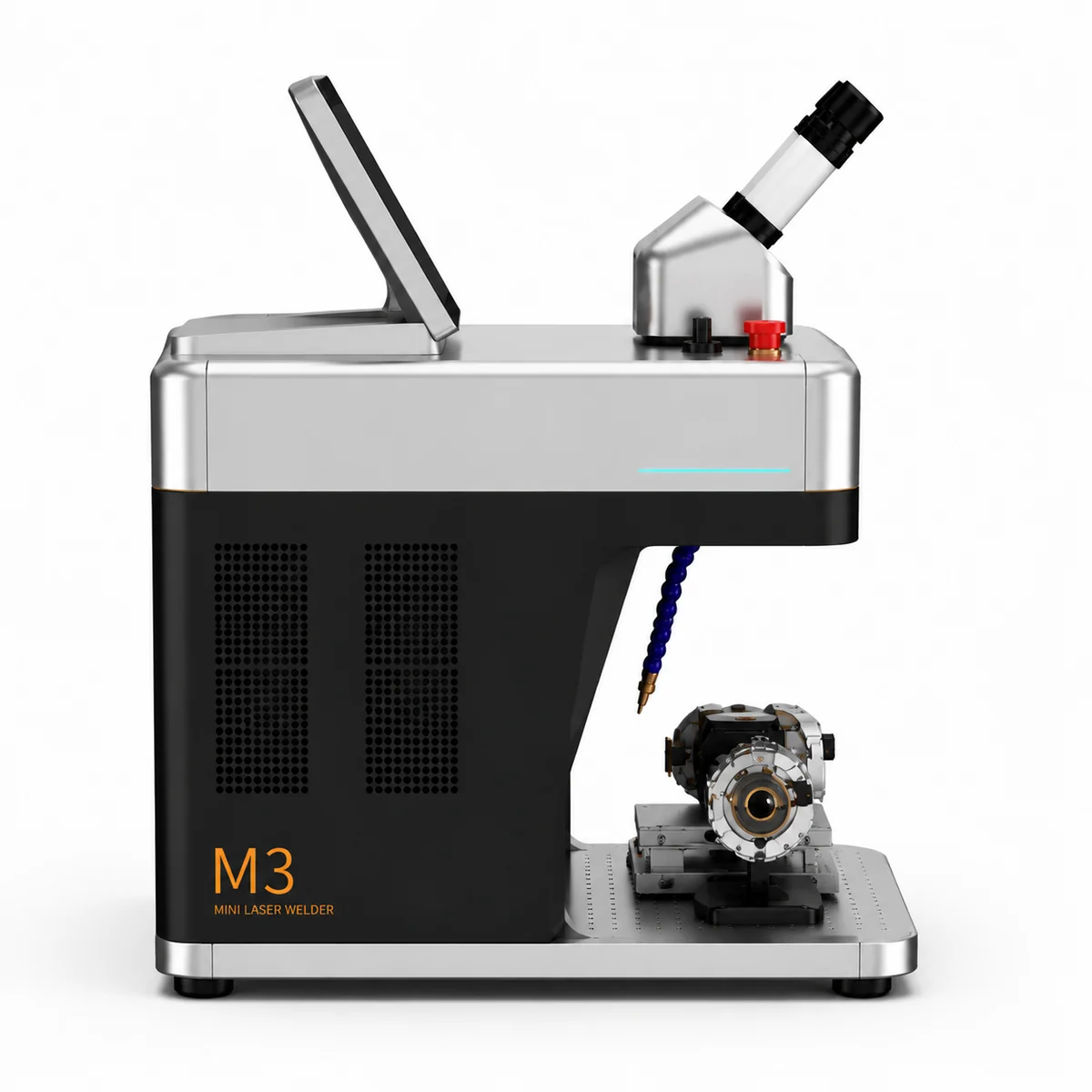
The rotary device belongs to the marking side.
Specifying for cutting work
| Item | How it is specified |
|---|---|
| MOPA fiber source | 10W / 20W / 60W. The right one follows from the pieces you cut, the metal you cut them in, and what else runs on the machine. Tell us what you make, or send a piece. |
| Cutting fixture | Standard kit for cutting work. Specified with the machine. |
| Fume extraction | Standard kit for cutting work. Specified with the machine. |
| Rotary device | Belongs to the marking side, for work that curves around a band. Specified when you do that work as well. |
| Screen and files | 10 inch 1280P Android touchscreen. Files load over Bluetooth, Wi-Fi or USB, so there is no separate computer to find bench space for. |
| Power and cooling | AC 220V, 50 Hz, 2 A, a total draw of 2 kW. Ambient 0 to 40 °C, air cooled, no chiller to plumb, fill or maintain. |
| Warranty | Two years on the laser source, one year on the machine. Lenses and consumable parts are not covered, stated here rather than discovered later. The routine consumable is the protective lens. |
| Rated source life | >100,000 hours, a rating on the source — not a machine life and not a warranty term. |
Who cuts on it
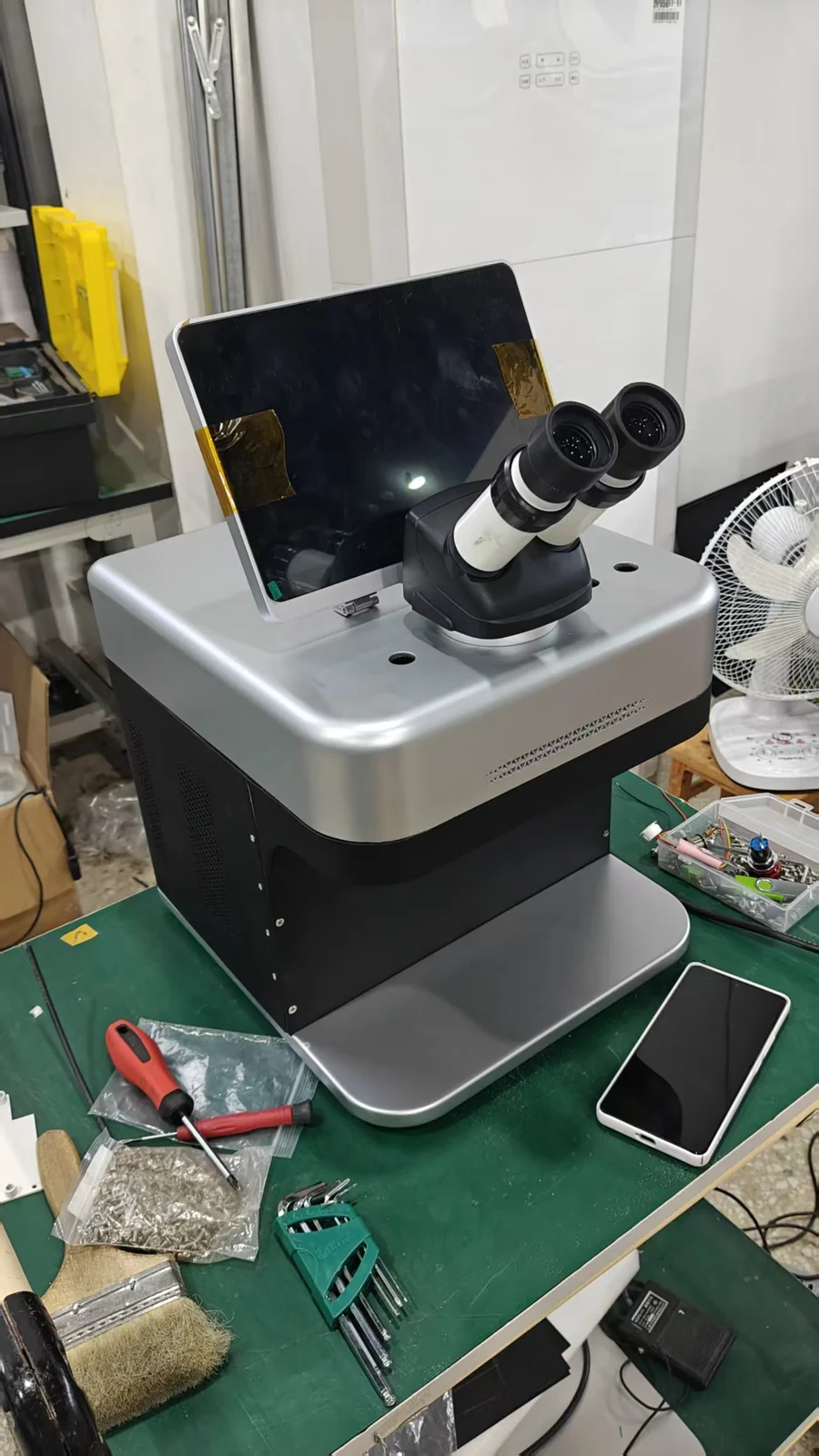
300 × 340 × 320 mm, 30 kg. Phone beside it for scale.
Send a cutting sample
Send the artwork you would most like to stop sending out, with a piece of the sheet you work in. It comes back cut, with the settings written down.