M3 · Jewelry Laser Workstation
Jewelry Repair Equipment forthe Decision Before the Weld
A repair bench does not lose pieces on the weld. It loses them on the decision taken before it: what the last repair left in that joint, how thin the wall is under the plating, whether that stone stays where it is.
The weld takes seconds. Everything that decides whether it holds happens before the pedal goes down.
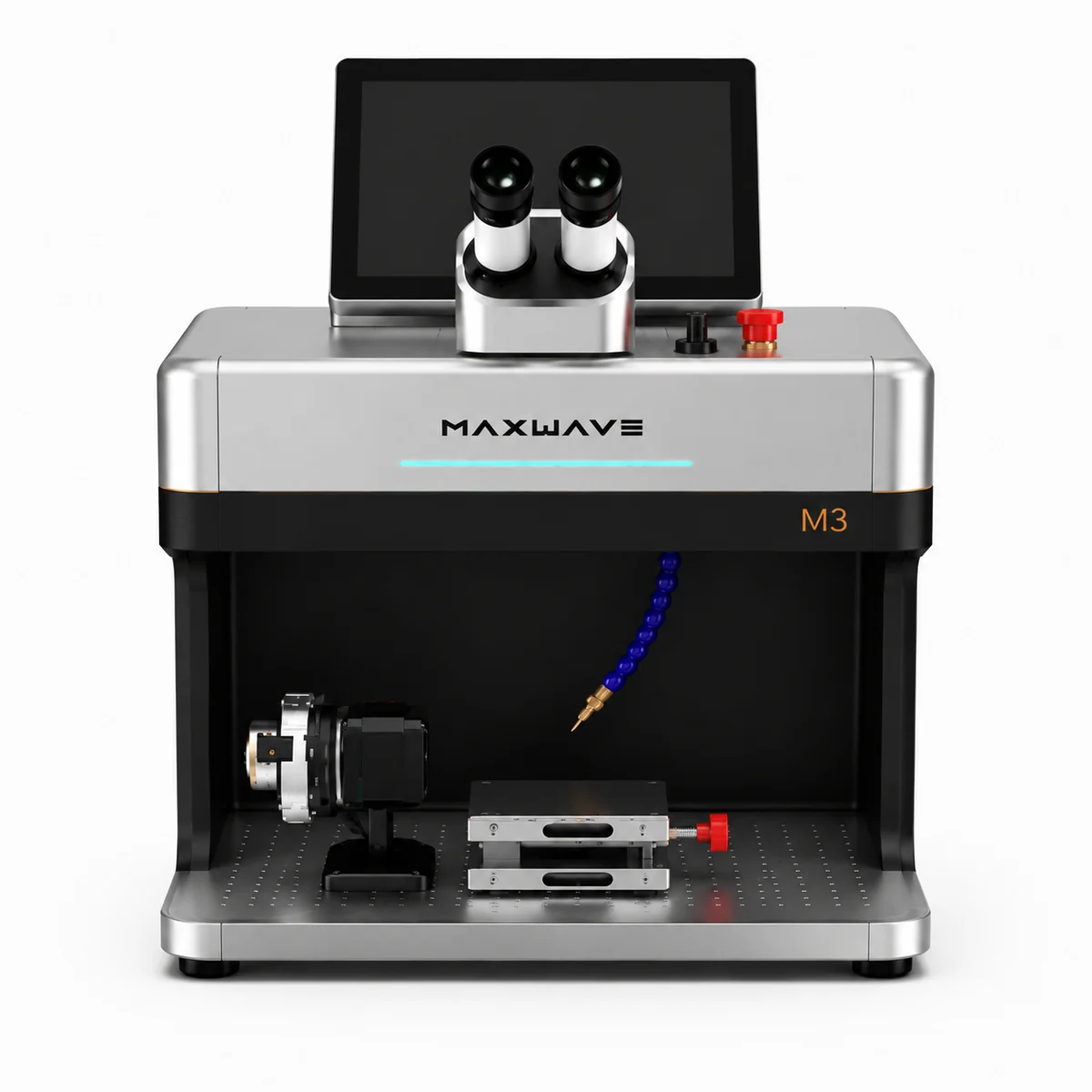
The short list, repeated
Jewelry Repair Equipment at the Counter
Eight jobs fill a repair bench, and every one of them is decided by something other than the weld itself.
Ring resizing
Decided by how many times the shank has already been worked.
Chains and clasps
Decided by link geometry and how much metal is left at the wear point.
Prong retipping
Decided by what is sitting three millimetres away from the tip.
Bead and grain setting
Decided by how much heat the grain takes before it rounds off.
Posts and findings
Decided by the joint under the head rather than by the finding itself.
Hollow bangles and tube
Decided by a wall thickness nobody can see from outside.
Porosity and casting pits
Decided by how far the porosity runs past the pit you can see.
Second repairs
Decided by what the first repair was done with, not by the crack.
Most of that list is judgment. Judgment is where a bench keeps the job or sends it out, and it is the part a machine specification never answers.
Full M3 specifications Who the M3 suitsRead the joint first
Jewelry Repair Equipment Assessment: Old Solder
A piece that has been repaired before is the most common way a straightforward laser job turns into a rebuild.
Gold and silver solder melt at a different temperature than the parent metal and sit as a distinct band inside the joint. Soft solder — the lead and tin kind that comes off a costume repair or an amateur fix — is worse. Under a pulse it boils, spits, pits the surface around the melt point and drives contamination into the parent metal, where it cracks later.
Where there is soft solder, the joint is cut out and rebuilt in sound metal. Welding over it costs the whole area around the joint, because the contamination travels further than the pit that is visible.
| What you see under 10X | What it means |
|---|---|
| A colour difference along the seam | A second metal is sitting in the joint |
| A grey or dull line in bright metal | Solder, not parent metal, at the surface |
| A fillet slightly sunk or slightly proud | The joint was filled rather than fused |
| An area that polishes to another tone | Seam and parent metal are not the same alloy |
| Spit at the trial pulse | Contamination — stop, go back to assessment |
Plating
Rhodium over white gold, gold plate over silver, plate over base metal. Around a melt point the plating burns back and leaves a ring the customer finds the moment they look at the piece in daylight.
The colour break shows at the shank underside and the high wear points, and the inside of a band is where plating wears through first. A plated piece is quoted with the replating included, decided at intake rather than discovered at handover.
Wall thickness
Hollow Sections, Thin Walls, Existing Cracks
A pulse sized for a solid shank goes straight through a hollow one. Hollow bangles, hollow rope chain, tube settings, spun beads and stamped forms all arrive looking solid, and three readings separate them.
Weight in the hand
Against apparent size. A bangle that looks like eighteen grams of metal and weighs six is hollow.
A seam line
Running the length of a tube or a link, where sheet was rolled and closed rather than drawn solid.
Flex under the thumb
A section that gives under light pressure has a wall too thin to take a full pulse without opening.
Where the wall is thin, the joint is built with a closed spot and repeated low energy pulses, each one allowed to cool, with a backing set inside the section wherever the form allows it. Blow-through leaves a hole in a curved thin wall, and closing that properly takes longer than the repair the customer brought in.
A shank sized twice work hardens along the old seam, and cracks radiate from it. A cast piece with porosity has more porosity than the pit in front of you. Weld one crack closed and the next one opens along the same line. Where the cracking runs through a worn cast section, the call is a new shank rather than a chain of welds.
Before the pedal
Holding, Focus and the Working Position
How the piece sits decides more of the result than the settings do. Firing runs on a foot pedal, so neither hand reaches for a trigger and both stay on the work for the whole job.
- Ring on a mandrel, seam upA molten pool follows gravity and surface tension, and runs off a joint presented on its side.
- Chain under light tensionSo the link closes on its own line instead of being welded open where it sat.
- Prong bent clear, or shieldedBent away from the stone where the setting allows it, or approached from the side furthest from it.
- Sheet and findings on flat backingNothing shifts at the moment the pulse lands, and nothing has to be re-aligned afterwards.
Heat sinking is part of the holding. Metal set in the path between the joint and whatever must not get hot pulls heat out of the piece during the pulse train. On a setting, that is the difference between a stone that stays and a stone that does not.
Focus on the joint itself, not the surface beside it — the melt point lands where the optics are focused.
Observation runs HD against the 480P configurations common in this class of machine.
One pulse, five readings
First-Pulse Trial and the Five Readings
Every job starts with one pulse, deliberately below where you expect to end up, placed somewhere that will be finished away or never seen: inside the shank, under a bezel, the back of a finding, the reverse of a bail.
Depth
How far it went, read by the size of the depression and by the sound of the pulse.
Spread
How wide the melt point ran, measured against the seam you have to fill.
Wetting
Whether the pool pulled into the parent metal or sat on top of it as a bead.
Spit
Anything that spat is contamination sitting inside the joint, not a settings problem.
Colour
What the metal went around the point — on silver and on plated work, the part a customer sees.
The material dial gives the starting point for the metal in front of you. The trial pulse says how far off that starting point this particular piece sits. One pulse turns an unfamiliar piece into a known one before any visible surface has been touched.
Before the polishing motor
Inspection, Recovery and Unrecoverable Welds
The weld is inspected under the same microscope it was made under, at the same magnification, before the piece goes anywhere near the wheel. Four things are looked for, and each one has its own way back.
| Defect | What it is | Recovery |
|---|---|---|
| Undercut | The edge of the pool has eaten into the parent metal and left a groove that shows as a line after finishing. | Built back up with low energy passes along the edge before the piece is finished. |
| Pinhole | Gas that did not escape, sitting at the centre of a melt point. | Re-melted with a smaller spot and less energy to let the gas out — never filled over with more metal. |
| Lack of fusion | A seam that looks filled but carries a fine continuous line along it. The failure that survives polishing and returns months later. | Cut back to sound metal and started again. Nothing added on top of it bonds. |
| Spread discolouration | More heat went into the piece than the settings suggested it would. | Settings back to the trial reading before the next joint on the same piece. |
Blow-through on a thin section gets a backing piece and is rebuilt from behind. A contaminated joint is removed entirely. A laser weld is not accepted here until it has been polished.
Four readings, judged together
Stone-Set Assessment on Jewelry Repair Equipment
We do not publish a list of stones that are safe to weld near and stones that are not. A list is a promise about a piece nobody has seen.
What can be given is the method, and the method is four things judged together rather than looked up separately.
Species
Heat behaviour has nothing to do with hardness. Some stones take a thermal gradient without complaint. Some are organic. Some hold water in their structure. Some are porous and take in whatever is on the bench. Some are assembled from two or three pieces with a cement line, or filled with glass or resin — and the filling moves long before the stone does.
Treatment
Oiled, fracture filled, dyed, surface coated, irradiated, diffusion treated. A treated stone and the same species untreated are two different jobs with two different answers. Treatment is the thing a customer is least likely to know about their own piece, and where it cannot be established it is treated as present.
Setting structure
A prong setting lets heat run out along the metal and usually lets the prong be bent clear or the stone lifted. A bezel, a channel or a pavé field wraps the stone in metal with no path out, so the heat you put in travels toward the stone. Glued components are their own category and come off first.
Distance from the weld
Distance only carries meaning in combination with the other three readings. Three millimetres on a prong-set diamond and three millimetres on a bezel-set opal are two different answers, and neither of them can be looked up.
Where our answer is to unset first
- Stones wrapped in metal inside the heat path
- Assembled or filled stones of any kind
- Organic and water-bearing material near the joint
- Any piece whose treatment history cannot be established
On those the sequence is unset, weld, reset, and it is quoted as what it is rather than attempted as a shortcut.
For a bench that cannot make the call on a particular piece, the way through is to send it. We run it, and we write back what we did — or why we would take the stone out first.
Pulse after pulse
Repeatable Energy, Pulse After Pulse
The weld that costs a repair bench most is the one that behaves differently from the weld before it at the same setting, because that is the one nobody goes back and checks.
2021 · Istanbul
A customer welding bracelets was losing pieces intermittently.
Symptom
The settings were not changing. The results were.
Cause — ours
The laser waveform had no compensation, so the energy delivered drifted between pulses.
Change
A voltage regulation stage was added to the mainboard, and it has been in the power stage since.
Twenty chain repairs is twenty of the same weld, not twenty separate judgments.
Power stage runs a German Infineon IGBT
Where it stands
Bench Space, Power and Cooling
Where it goes in a working shop
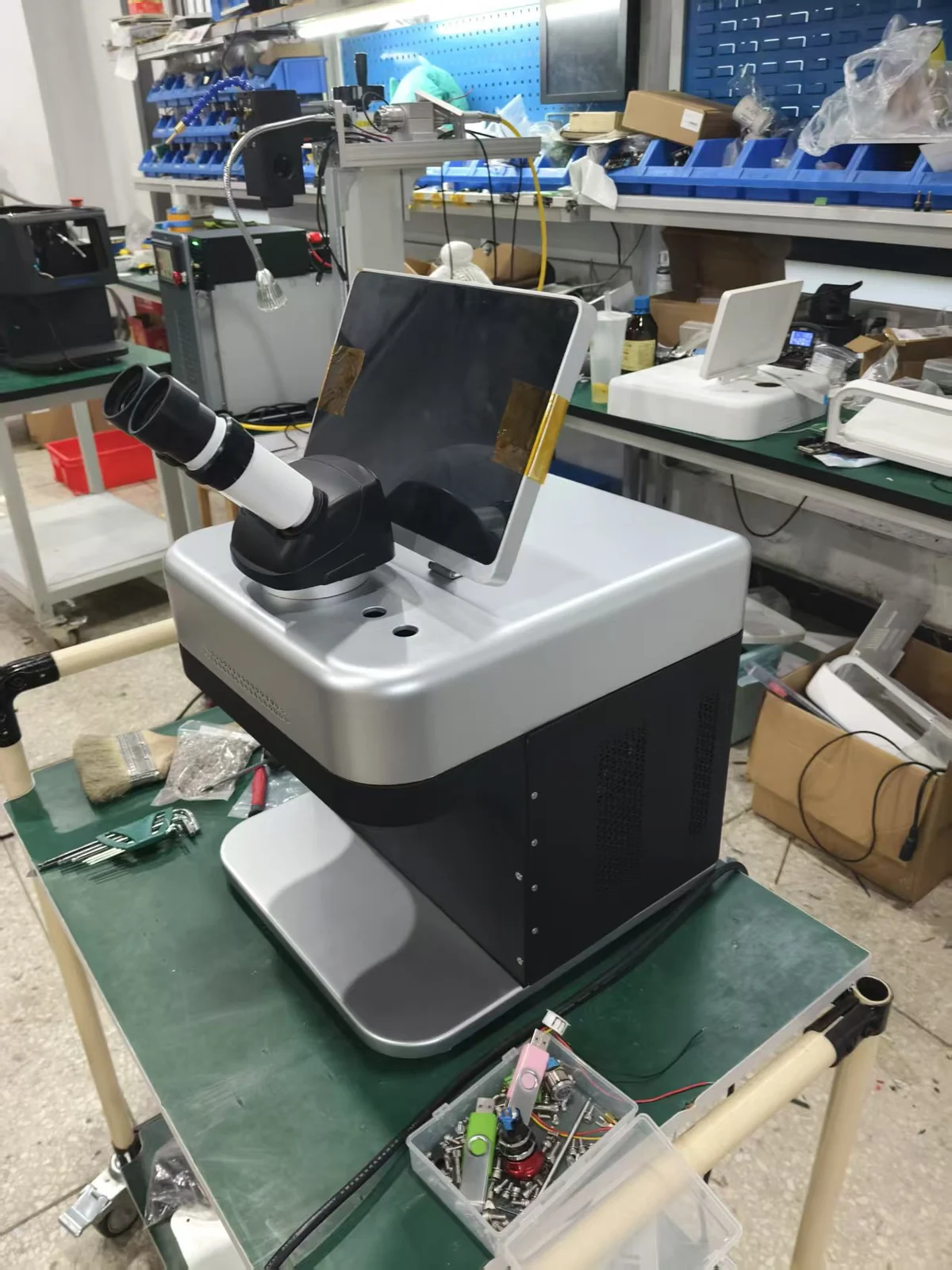
It stands on a back room bench beside the polishing motor, or on a counter where a customer can watch. Two people move it without equipment, and nothing runs across a floor that is walked with other people's property in hand. No chiller to find space for, no hoses, no water circuit to sit behind the machine. Working environment 0 to 40 degrees C.
300 mm across the bench
Splitting the queue
Master on Eyepieces, Apprentice on Screen
The constraint in most repair shops is that one person in the building can do the work, and everything queues behind that person. Equipment is rarely what holds the queue up.

The bench owner keeps the judgment
Work that turns on a reading rather than on a setting stays with the person who can make the reading.
- stone-set work
- hollow sections
- pieces back from a previous repair
The apprentice takes the volume
At HD resolution and at a size a second person can work from, the joint is large enough to place a melt point accurately without years on an eyepiece.
- chain repair
- jump rings
- bead re-seating
- porosity fill
- findings
The customer stands and watches
A customer can watch their own ring go through instead of handing it to a stranger for a week. That is the part of an in-house repair service that brings them back next year rather than sending them to a chain store.
Operating and maintenance videos sit in the machine itself, on the same screen used to run it, so a new operator learns from the machine in front of them.
What it costs to keep running
Jewelry Repair Equipment Consumables and Warranty
Stated here rather than discovered later.
A mini ultrasonic jewelry cleaner ships with the machine for the step that follows every repair.
- Routine consumable
- The protective lens. Replacing it is bench work rather than a service call, and it is the only part that comes out in normal use.
- Cooling
- Air. Nothing to top up, nothing to drain, no circuit to descale — the whole water side of maintenance leaves with the chiller.
- Rated source life
- >100,000 h on the fiber sources. A source rating — not a machine life, and not a warranty term.
- Warranty
- Two years on the laser source, one year on the machine. Lenses and consumable parts are not covered.
The hours between repairs
Marking and Cutting, Same Bench
Repair fills the bench. The second fiber source in the same cabinet fills the hours between repairs, and it sells to the customer already standing at the counter.
Mark
Inside and outside band text, turned under the head on the rotary device.
Engraving and colour markingEngrave
Logos, dates and serial numbers on flat pieces, at 0.01 mm marking accuracy.
What the MOPA source doesCut
Sheet cut into name necklaces, letter pieces and tags — which come back to the welding side for their jump rings.
Thin-sheet cuttingAn engraving request stops being a job referred elsewhere, and a repair customer becomes a personalization customer without a second machine, a second bench or a second operator.
Before any quotation
Sending a Test Piece
Send one piece: the repair you do most often, or the one you currently send out.
Tell us what you know about it
- The metal and karat, if you have it
- What the piece has been through before — sizing, plating, any previous repair
- Whether there are stones, and anything known about them including treatment
- Whether the section is hollow or thin walled
- What the finished repair has to look like when the customer collects it
What comes back
- The settings written down: which source, which material preset, the spot, the pulse width, the frequency and the power
- How the piece was held, and what it was held against
- Which of the four readings made the call, where we would take a stone out first
What you receive is a repair and the recipe for repeating it on your own bench.
Send your piece
Send Us a Piece
Tell us the repair that crosses your counter most often, and send one with it. It comes back with the parameters that ran it.
- [email protected]
- +86 18571639620 phone and WhatsApp
- Mon–Sat 09:00–18:00 (GMT+8)