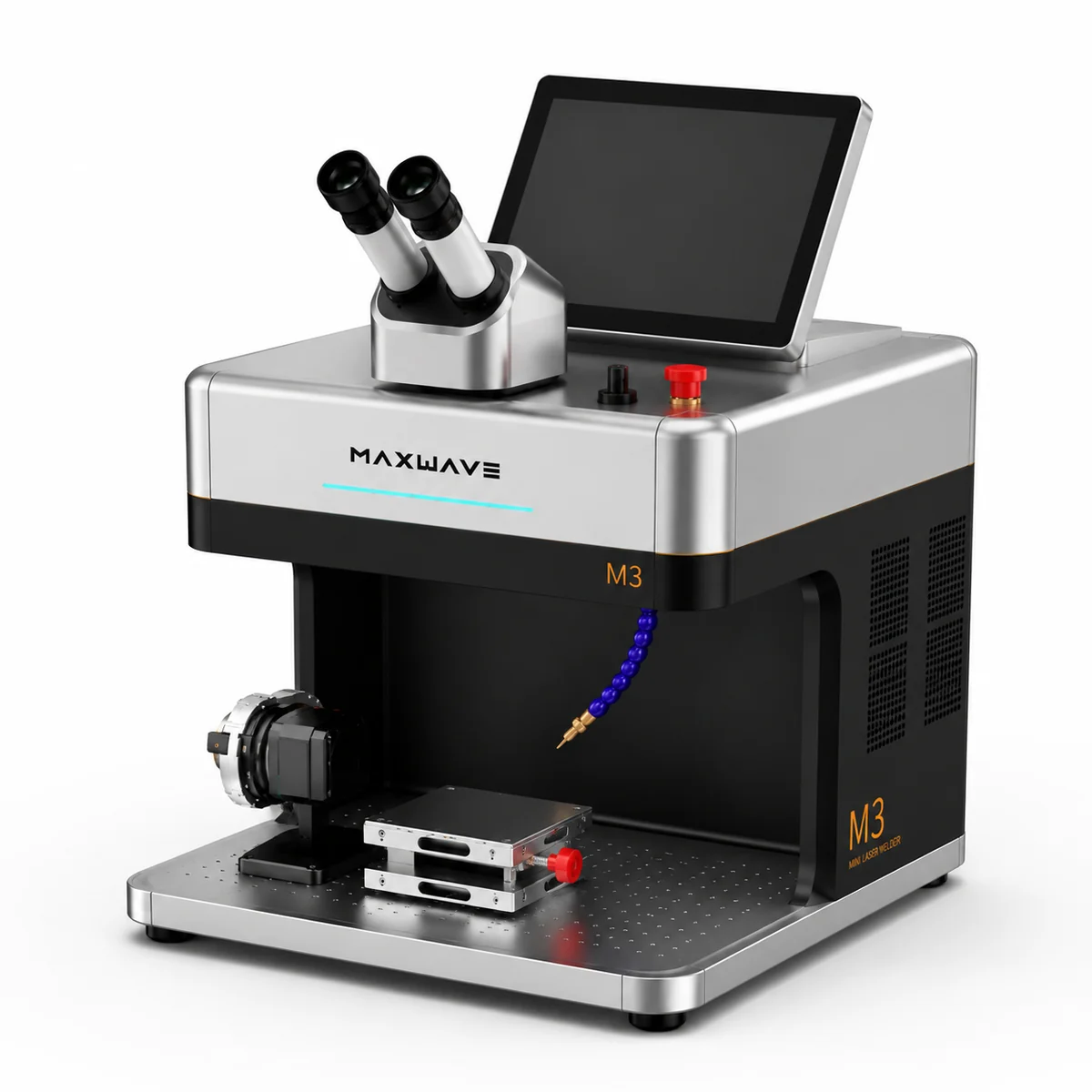
Jewelry laser welding is often the better choice for delicate, localized repairs, while traditional soldering remains effective for many simple joints and larger assemblies. The right method depends on the jewelry's material, design, gemstones, and the type of repair required.
For jewelry repair shops and goldsmiths, choosing between laser welding and soldering affects more than the finished joint. It can influence repair time, gemstone handling, finishing work, and the range of jobs your workshop can accept.
Traditional soldering remains an essential technique for ring resizing, chain repair, and jewelry assembly. However, repairs involving worn prongs, detailed settings, casting porosity, or heat-sensitive components can be more challenging when heat spreads beyond the intended joint.
A jewelry laser welder offers a different approach by concentrating energy into a small area, allowing jewelers to perform precise metal repairs with less heat spreading into surrounding components.
But does your jewelry business actually need one?
This guide compares jewelry laser welding and traditional soldering, explains which repair tasks benefit most from each method, and helps you decide whether investing in laser welding equipment makes sense for your workshop.
1. Jewelry Laser Welding vs Soldering: What Is the Difference?
The fundamental difference between jewelry laser welding and traditional soldering is how the two methods join metal.
Jewelry laser welding uses a focused laser beam to melt and fuse metal at a selected location. Jewelers typically work under a microscope or camera system, using controlled laser pulses to form a weld.
Depending on the repair, the operator may fuse the existing metal directly or add compatible filler wire to rebuild worn areas and fill small gaps.
Traditional jewelry soldering uses a torch to heat the joint and melt a lower-melting filler alloy. The solder flows between the prepared metal surfaces and joins them without melting the parent metal in the same way as fusion welding.
Both methods can produce reliable repairs when the materials, joint design, and working technique are appropriate.
Jewelry Laser Welding vs Soldering Comparison
Feature | Jewelry Laser Welding | Traditional Soldering |
|---|---|---|
Joining Method | Melts and fuses metal locally | Uses a lower-melting filler alloy |
Heat Distribution | Concentrated near the weld | Heat spreads across a broader area |
Precision | Adjustable, localized weld placement | Depends on torch control and solder flow |
Gemstone Considerations | May reduce the need to remove stones | Stones may require removal or additional protection |
Filler Material | Optional, depending on the repair | Solder alloy required |
Surface Finish | Can reduce visible seams with suitable filler | Can produce excellent results with correctly matched solder |
Best Applications | Prong rebuilding, fine repairs, porosity filling | Accessible joints, larger seams, general assembly |
Equipment Investment | Higher initial cost | Lower initial cost |
Skill Requirements | Laser settings, positioning, and weld inspection | Torch control, joint preparation, and soldering technique |
Why Does Localized Heat Matter?
When repairing jewelry, the metal around the damaged area can be just as important as the joint itself.
For example, a ring may contain gemstones, earlier solder joints, engraved details, or delicate settings that should not be exposed to unnecessary heat.
A torch heats a broader area, meaning heat can travel through the metal toward nearby components.
Laser welding concentrates energy at the selected spot, which can reduce the heat transferred to surrounding areas.
This is especially valuable when repairing small features or adding metal to a localized section of jewelry.
However, laser welding does not eliminate heat-related risks or automatically produce a stronger joint.
Weld quality still depends on penetration, material compatibility, joint preparation, filler selection, and operator skill.

2. Which Jewelry Repairs Benefit Most from Laser Welding?
The strongest reason for a jewelry business to consider laser welding is the ability to perform detailed repairs that may be difficult or inefficient with a torch.
Instead of asking whether laser welding is better for every repair, it is more useful to identify which jobs benefit from its precise energy delivery. Before buying, ask a jewelry laser workstation supplier which welding source and field size suit your repair mix.
Jewelry Repair Application Comparison
Repair Application | Recommended Approach | Main Consideration |
|---|---|---|
Fine Chain and Jump Ring Repair | Often laser welding | Localized joints and neighboring links |
Prong Retipping and Rebuilding | Often laser welding | Controlled metal buildup near settings |
Stone-Set Ring Repair | Laser welding when suitable | Reduced heat exposure to nearby components |
Casting Porosity Repair | Laser welding | Localized filling and surface restoration |
Simple Plain-Band Resizing | Often traditional soldering | Accessible seam and efficient joining |
Large, Well-Fitted Joints | Soldering or laser welding | Joint design, strength, and efficiency |
Antique and Detailed Jewelry | Case-dependent; laser often useful | Preserve original details and finishes |
Plated Jewelry | Case-dependent | Repairing the metal may damage plating |
Fine Chain and Jump Ring Repairs
Fine chains often contain closely spaced links that can be difficult to repair with a torch.
Applying heat to one link may affect adjacent links or existing solder joints, particularly when the chain is thin or closely assembled.
Laser welding allows the jeweler to target the damaged connection more precisely.
For example, a broken gold chain can sometimes be repaired by carefully aligning the link and applying controlled weld spots without spreading solder into neighboring links.
This may reduce additional finishing and help preserve the chain's flexibility.
However, simple accessible chain joints can still be repaired effectively by soldering. The best method depends on the link design, material, and condition.
Prong Retipping and Stone-Set Repairs
Prong repair is one of the applications where a jewelry laser welder can provide substantial value.
Over time, prongs can become worn, flattened, or damaged, reducing their ability to hold gemstones securely.
Traditional rebuilding with a torch may require removing the gemstone to protect it from heat.
Laser welding allows jewelers to add compatible metal to a worn prong using localized welds.
The added material can then be shaped and finished to restore the prong.
For suitable repairs, this can reduce the amount of disassembly required and make precise metal restoration more manageable.
A jewelry laser welding machine is particularly worth considering for workshops regularly handling prong retipping, complex ring settings, and other detailed repairs.
However, every gemstone and setting must be assessed individually. The laser beam, conducted heat, and mechanical handling can still damage sensitive or previously treated stones.
Casting Porosity and Surface Restoration
Casting defects are another application where laser welding offers a practical advantage.
Jewelry castings may contain small pores, pinholes, or localized surface defects that become visible during finishing.
A jewelry laser welder can add compatible filler material to selected defects without reheating the entire casting.
After welding, the repaired area can be filed and polished to blend with the surrounding surface.
This can be useful for custom jewelry manufacturers, casting workshops, and repair businesses handling detailed metal restoration.
For businesses working with high-value jewelry, the ability to correct localized defects may help reduce unnecessary component replacement and additional manufacturing work.

3. When Is Traditional Jewelry Soldering the Better Choice?
Although laser welding offers greater flexibility for many detailed repairs, traditional soldering remains valuable for jewelry workshops.
A laser welder should complement your existing bench techniques rather than automatically replace them.
Simple Ring Resizing and Accessible Joints
For a plain gold or silver ring without nearby heat-sensitive components, traditional soldering may be the most efficient method.
When the joint is properly fitted and the metal can be heated safely, a skilled jeweler can create a reliable seam using an appropriate solder alloy.
There may be little advantage in using laser welding if the repair is straightforward and the surrounding jewelry is not at risk.
However, stone-set rings or designs with delicate details may benefit from localized laser welding.
The deciding factor is the specific ring construction, not simply whether the repair involves resizing.
Larger Joints and Jewelry Assembly
Traditional soldering can also be practical for larger, accessible joints.
In these applications, solder can flow across a properly prepared joint surface, creating a suitable bond without requiring the operator to build the entire connection through individual laser pulses.
Examples include selected bracelet assemblies, pendant fittings, and ring shank connections.
Laser welding can also be used for some of these tasks, but it may require additional positioning, filler material, or multiple overlapping welds.
The most efficient method depends on the joint geometry and the required finished result.
When a Combination Works Best
Some jewelry repairs benefit from using both methods.
For example, a jeweler may use laser welding to secure or rebuild a delicate component, then use traditional soldering for another accessible connection within the same piece.
The processes can complement each other, provided the sequence, alloy compatibility, and thermal effects are considered.
For a professional jewelry repair shop, the goal is not to replace every soldering task with laser welding. It is to choose the method that delivers the required repair quality with the least unnecessary work and risk.
4. How Do Metals and Gemstones Affect the Repair Method?
Different jewelry metals and gemstones respond differently to heat and welding.
A method that works well for a plain yellow gold ring may not be suitable for a delicate silver chain or an antique piece containing treated gemstones.
Understanding these differences is important when evaluating a jewelry laser welding system.
Gold, Silver, and Platinum Repairs
Gold Jewelry
Both laser welding and traditional soldering are widely used for gold jewelry.
Traditional soldering remains suitable for many straightforward joints, including accessible ring seams and component assembly.
Laser welding is particularly useful for localized repairs, worn prongs, fine chain connections, and adding metal to damaged areas.
The exact gold alloy matters. Yellow, white, and rose gold can behave differently during welding, so filler selection and settings should be matched to the material.
Silver Jewelry
Silver presents additional challenges because of its high thermal conductivity and reflectivity.
Traditional soldering is a well-established method for many sterling silver repairs, especially accessible joints and larger assemblies.
Laser welding can also be effective, but the machine must provide suitable energy control and the operator must develop settings for the specific silver alloy.
For a workshop processing different precious metals, silver welding performance should be demonstrated before purchasing equipment from a gold, silver and platinum laser welder supplier.
Platinum Jewelry
Platinum can be repaired using suitable laser welding or traditional joining procedures.
Laser welding is particularly useful for precise platinum repairs, including prongs, small cracks, and selected ring connections.
For larger assemblies, the choice depends on joint design, material grade, and repair requirements.
Can You Laser Weld Near Mounted Gemstones?
One of the main advantages of jewelry laser welding is its ability to concentrate heat near the intended repair area.
In suitable circumstances, this may allow a jeweler to repair a prong or nearby metal connection without removing the gemstone.
However, there is no universal safe laser-to-gemstone distance.
Gemstone type, treatments, fractures, adhesives, mounting geometry, and the direction of the laser beam all affect the risk.
Pearls, opals, emeralds, fracture-filled gemstones, and other sensitive materials require particular caution.
Even diamonds and sapphires can be damaged under unsuitable conditions.
Before attempting a stone-adjacent repair, inspect the gemstone and setting carefully. Remove the stone if the risks cannot be adequately controlled.
The ability to work near gemstones is a major advantage of a laser welder for jewelry, but it should never be presented as a guarantee that every mounted stone can remain in place.
Antique, Plated, and Delicate Jewelry
Antique jewelry may contain old solder joints, fragile settings, enamel, adhesives, or materials that are difficult to identify.
Localized laser welding can be useful when preserving surrounding details is important.
However, an antique piece may also require a conservation approach that prioritizes reversibility and preservation of original construction.
Plated jewelry presents another challenge because both soldering and laser welding can damage the coating around the repair.
The underlying metal may need to be repaired and the surface refinished or replated afterward.
For these pieces, choosing the correct repair method is more important than minimizing the number of processing steps.

5. Is a Jewelry Laser Welder Worth Buying for Your Shop?
For jewelry repair businesses, the decision to buy from a repair shop laser welder supplier should be based on the work your shop handles and the services you want to offer.
A workshop performing occasional simple soldering jobs may not need a dedicated laser welding system.
However, a professional repair shop regularly working on stone-set rings, damaged prongs, fine jewelry, and casting defects may benefit from the additional capabilities.
When Does Laser Welding Add Business Value?
A jewelry laser welder becomes more attractive when it helps your workshop complete repairs that would otherwise require additional disassembly, more extensive finishing, or outsourcing.
For example, a shop frequently rebuilding prongs on valuable rings may benefit from the ability to place controlled welds in small areas. A jewelry repair equipment supplier can show how that works on prong and ring jobs.
A jewelry manufacturer repairing casting defects may use laser welding to add material only where necessary.
A repair center handling complex customer pieces may also benefit from more flexible welding options.
These capabilities can help a workshop expand the types of repair services it offers.
However, the financial benefit depends on repair volume, equipment utilization, operator skill, maintenance costs, and customer demand.
How to Evaluate the Investment
Before purchasing a jewelry repair laser welder, review your workshop's actual repair history.
Identify how many jobs involve prong rebuilding, delicate chains, stone-set rings, casting defects, or other work that may benefit from laser welding.
Then consider whether the machine could reduce outside repair costs, additional handling, or the time needed for suitable repairs.
Also evaluate the repairs your business currently declines because the available equipment is not appropriate.
These are potential business opportunities, but they should be estimated realistically rather than treated as guaranteed additional revenue.
For most workshops, a purchasing decision should consider both the capability to perform new repairs and the efficiency of existing work. Weigh those gains against jewelry laser welder manufacturer pricing and configuration options.
What Should You Look for in a Jewelry Laser Welder?
When comparing equipment, focus on the requirements of your actual repair tasks.
Equipment Feature | Why It Matters |
|---|---|
Adjustable Pulse Energy | Helps control the welding process for different joint sizes |
Pulse Width Control | Supports adjustment of heat input and weld formation |
Adjustable Spot Size | Allows more flexibility for fine repairs and larger joints |
Microscope or Camera | Supports accurate positioning and inspection |
Compatible Filler Wire | Helps rebuild prongs and fill damaged areas |
Shielding Gas Support | Can reduce oxidation for suitable metals and procedures |
Cooling System | Must support the intended operating workload |
Technical Support | Important for training, troubleshooting, and maintenance |
For a small repair workshop, a compact desktop jewelry laser welder may be worth evaluating if it offers the necessary precision and working space.
Larger repair centers and jewelry manufacturers may prioritize sustained operating capacity, repeatable settings, and convenient operation across multiple repair types.
The best way to compare machines is to request demonstrations using jewelry samples similar to the work your business handles.
Ask the jewelry laser welder supplier to show the actual weld quality, finishing requirements, and machine controls rather than relying only on rated power.
Jewelry laser welding also requires an appropriate laser-safe enclosure or protective system, trained operators, and suitable fume extraction. Safety provisions should be part of the equipment evaluation, not an optional extra.

Conclusion
Jewelry laser welding and traditional soldering both have an important place in professional jewelry repair. The better method depends on the material, joint design, surrounding components, and required finish.
Traditional soldering remains practical for accessible joints, plain ring resizing, and many conventional jewelry assembly tasks.
Laser welding offers additional flexibility for precision repairs, particularly worn prongs, fine chains, casting porosity, detailed settings, and selected repairs near mounted gemstones.
For jewelry repair shops and goldsmiths, the greatest value of a laser welder is not replacing every torch operation. It is expanding the range of repairs the workshop can perform while offering more control over localized metal restoration.
Before investing, review your typical repair jobs, compare configurations from a multi-function jewelry laser machine supplier, and request demonstrations on representative jewelry samples.
Looking to expand your jewelry repair capabilities with laser welding? Contact M3Welder to discuss your repair applications, materials, and workshop requirements. Explore suitable jewelry laser welding equipment and request information about the configurations, demonstrations, and support available for your business.